Ancient harbors that built the first global trade routes
The history of humanity is a story of expansion and connection across the vast horizons of the sea. Ancient civilizations recognized early on that the ocean was a bridge rather than a barrier. To utilize this bridge, they needed to build permanent structures where ships could safely load and unload goods. These early developments in ports and harbors laid the foundation for global trade and political power. From the shores of the Red Sea to the coasts of India, the construction of maritime hubs transformed the ancient world into an interconnected network of exchange.
The first harbors and their historical records
The oldest evidence of an artificial harbor comes from the coast of Egypt. Archaeologists working at the site of Wadi al-Jarf discovered a complex maritime system that dates back to approximately 2580 BCE. This location served as a vital link for King Khufu during the Fourth Dynasty. The site features a massive limestone pier that extends into the Red Sea in an L shaped configuration. This structure provided a sheltered area for ships to anchor while they waited for copper and turquoise from the Sinai Peninsula.
We have a unique understanding of this port because of the discovery of the Merer Logbooks in 2011. These papyrus scrolls are the oldest ever found. They provide a daily account of the activities of a crew involved in the construction of the Great Pyramid of Giza. The logs describe the transport of limestone blocks across the Nile and the logistical support provided by coastal ports. These documents offer a glimpse into the bureaucratic efficiency of the Old Kingdom. They prove that the Egyptians possessed a highly organized system for maritime management long before other civilizations began similar projects.
The masters of Mediterranean engineering
The Phoenicians emerged as the premier maritime civilization of the Iron Age around 1200 BCE. They settled in cities like Tyre and Sidon on the coast of modern day Lebanon. These people were responsible for several breakthroughs in harbor construction. They pioneered the use of the cothon, which was an artificial inner harbor carved directly into the land. This design allowed ships to be protected from both the elements and enemy attacks. The Phoenicians used these ports to facilitate the trade of purple dyes, cedar wood, and glassware across the Mediterranean basin.
Following the Phoenician era, the Greeks refined these techniques during the Classical period between the 5th and 4th centuries BCE. The port of Piraeus in Athens became the largest maritime center in the Aegean. The architect Hippodamus of Miletus designed the city and its harbor using a grid system around 450 BCE. This urban planning made the port a hub for both commercial trade and military dominance. The Greeks also began using stone breakwaters to protect their ships from the powerful Mediterranean swells.
The Roman Empire took maritime engineering to its zenith starting in the 1st century BCE. They developed a unique type of hydraulic concrete that could set underwater. This material consisted of lime and volcanic ash known as pozzolana. By using this technology, the Romans built massive offshore breakwaters at sites like Portus near Rome and Caesarea Maritima in Judea. The construction of Portus under Emperor Claudius in 42 CE and later expansion by Trajan in 113 CE created a hexagonal basin that could accommodate hundreds of ships simultaneously.
The beacon of the ancient world
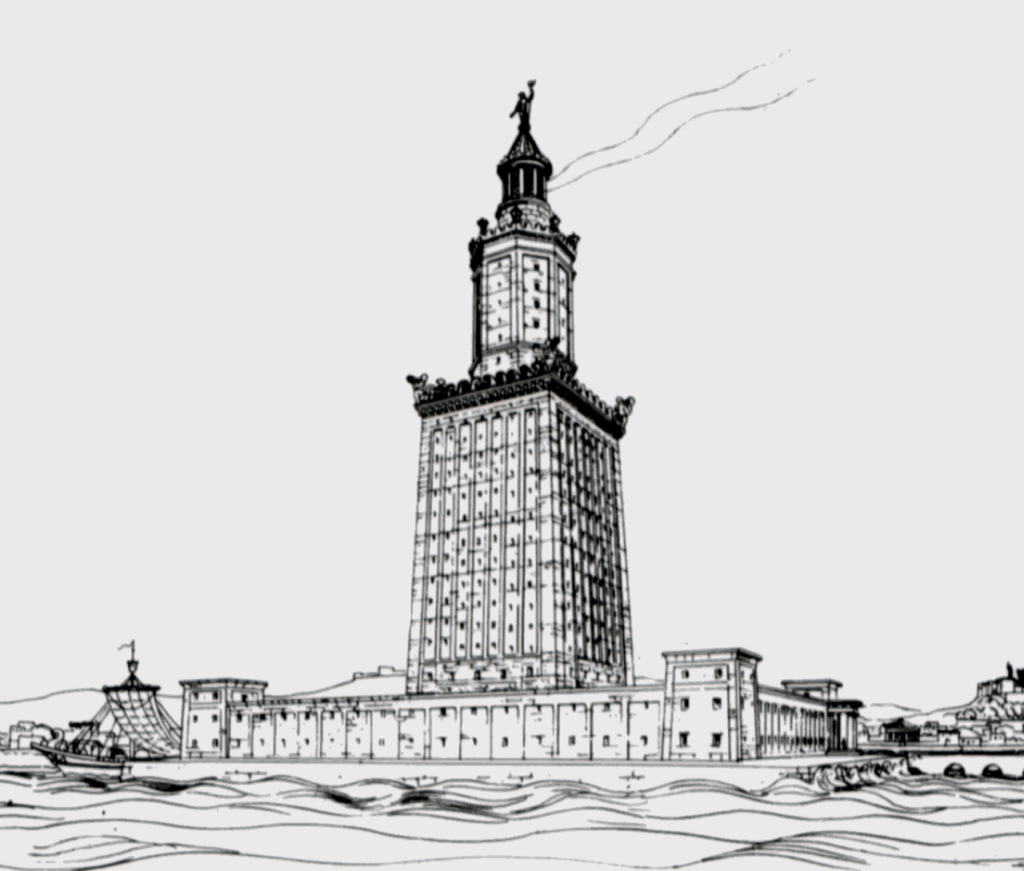
As ports grew in size and complexity, the need for navigational aids became critical. The most famous solution to this problem was the Lighthouse of Alexandria. This structure stood on the island of Pharos in Egypt. It was commissioned by Ptolemy I Soter around 290 BCE and completed by his son, Ptolemy II Philadelphus, approximately ten years later. The architect Sostratus of Cnidus oversaw the project. It served as a monumental symbol of the power and scientific achievement of the Ptolemaic Kingdom.
The lighthouse reached a height of roughly 100 meters. It was constructed in three distinct tiers. The lowest section was a square base that housed workers and animals. Above this sat an octagonal middle section. The structure finished with a circular tower at the very top. The builders used large blocks of light colored limestone and granite. They used molten lead to secure these blocks against the corrosive effects of the salt air.
The function of the lighthouse was both practical and symbolic. At the summit, a large fire burned throughout the night to guide sailors toward the harbor. During the day, a massive bronze mirror reflected the sunlight to create a signal that was visible from many miles away. This technology ensured that ships could avoid the treacherous reefs surrounding the Egyptian coast. The Pharos was so influential that its name became the root word for lighthouse in many languages, including French and Spanish.
Global maritime developments from Asia to the Americas
Ancient maritime innovation was not limited to the Mediterranean region. In South Asia, the Indus Valley Civilization built the city of Lothal around 2400 BCE. This site featured the world’s first known tidal dock. The Harappan engineers designed a brick lined basin that could be filled and drained with the tides. This allowed ships to remain afloat while they were being serviced. Lothal connected the Indian subcontinent to the Persian Gulf and facilitated the trade of beads, metals, and ivory.
In East Asia, the Chinese began developing sophisticated ports during the Han Dynasty around 202 BCE. The city of Guangzhou served as a primary gateway for the Maritime Silk Road. Chinese shipbuilders developed the stern post rudder and watertight compartments during this period. These inventions made long distance travel more reliable. Consequently, the Chinese ports became central hubs for the exchange of silk, spices, and porcelain with Southeast Asia and India.
Across the ocean, the civilizations of the Americas also engaged in maritime activities. The Maya people established coastal trade routes around 600 BCE. They built ports at sites like Tulum and the island of Cozumel. These locations were used to distribute salt, honey, and obsidian along the Yucatan Peninsula. While their technology differed from the stone docks of the Romans, the Maya used these coastal sites to maintain a complex political and economic network that spanned hundreds of miles.
The foundations of ancient maritime success
The remarkable achievements in port and lighthouse construction were the result of specific social and technological conditions. Centralized political power allowed leaders to mobilize the massive resources required for these projects. Emperors and kings viewed maritime infrastructure as a way to project their influence and ensure the food supply for their growing populations. For example, the Roman grain fleet was entirely dependent on the safety and efficiency of the harbors at Alexandria and Portus.
The development of mathematics and geometry also played a crucial role. Engineers used these disciplines to calculate the angles of breakwaters and the structural stability of tall towers like the Pharos. Furthermore, the availability of specialized labor provided the physical force necessary to move stones weighing several tons. The social structure of these ancient societies allowed for the long term planning needed to complete projects that often took decades to finish.
The evolution of ship technology also forced the evolution of the ports. As vessels grew larger and moved from oars to sails, they required deeper channels and more sophisticated docking systems. The interaction between shipbuilders and civil engineers created a cycle of innovation. This progress transformed the sea from a dangerous mystery into a regulated highway for human commerce and culture. The legacy of these ancient systems continues to influence how we build and manage our modern global ports today.