

The history of numbers: from tally marks to zero
Numbers are older than any civilization we know. Long before the first cities rose along the Tigris or the Nile, human beings were already counting, recording, and reasoning. Our ancestors needed ways to track the passage of time and the quantity of their resources. Consequently, they developed the first numerical codes to bring order to their expanding worlds. These early systems laid the groundwork for the modern technology and science we use today.
The first marks on bone
The earliest evidence of mathematical thinking exists in the form of tally sticks. For instance, the Lebombo bone found in the Border Cave in the Lebombo Mountains dates back to approximately 35,000 BCE. This artifact is a baboon fibula with twenty nine distinct notches carved into its surface. Archaeologists believe it served as a lunar calendar or a device for tracking menstrual cycles.
Similarly, the Ishango bone was discovered in what is now the Democratic Republic of Congo. Dating to roughly 20,000 BCE, it is covered in deliberate notch markings arranged in three columns. Researchers believe those markings represent a tally system, and some even suggest they encode knowledge of prime numbers or lunar cycles.
This artifact predates writing by more than 15,000 years. Nevertheless, it shows that early humans had already developed a need to count and a method to record those counts. That impulse would eventually become the engine of civilization.
Mesopotamian clay and the power of sixty
The leap from tally marks to symbolic numerals happened gradually, across multiple cultures. The earliest written mathematics comes from Mesopotamia. Around 3000 BCE, the Sumerians developed a system of metrology focused primarily on administrative tasks, such as recording grain allocations, workers, and silver weights. By approximately 2500 BCE, they were producing multiplication tables carved into clay tablets.
The Mesopotamians utilized a sexagesimal system, which is a base sixty system. This choice was highly practical because sixty has many divisors. For example, it can be divided by two, three, four, five, six, ten, twelve, fifteen, twenty, and thirty.
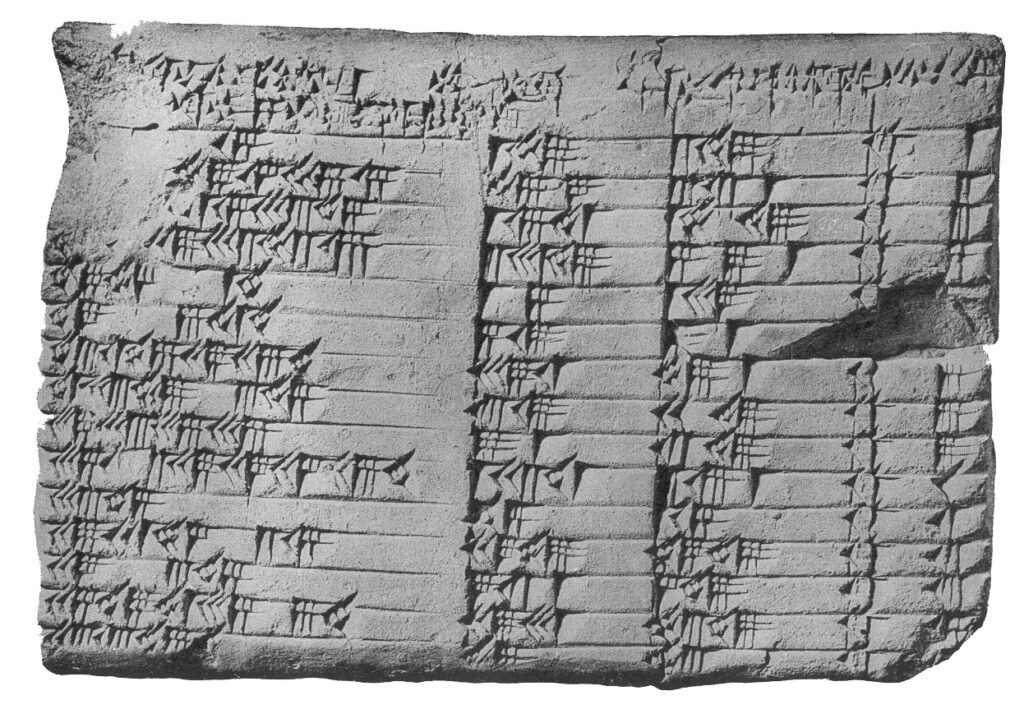
We still see the legacy of this Mesopotamian invention in our modern clocks and compasses. We divide an hour into sixty minutes and a circle into three hundred and sixty degrees. Furthermore, the Babylonians,who succeeded the Sumerians in the same region, left even richer records. The Plimpton 322 tablet, dated to around 1900 BCE, contains a list of Pythagorean number triples that suggests a sophisticated understanding of geometry, emerging more than a millennium before Pythagoras was born. Those tablets survive in cuneiform script and remain in museum collections to this day.
Egyptian symbols and practical geometry
In Ancient Egypt, mathematics was a tool for engineering and governance. The Egyptians developed a decimal system using hieroglyphics as early as 3000 BCE. They used specific symbols for one, ten, one hundred, and higher powers of ten. However, they did not use a positional system like we do today. They simply repeated symbols to reach the desired amount.
The Rhind Mathematical Papyrus, dating to approximately 1650 BCE, provides deep insight into their methods. This document contains eighty four problems involving fractions, area, and volume. The Egyptians needed these skills to survey land after the annual flooding of the Nile River. In addition, they applied geometry to construct the Great Pyramids with extreme precision.
Education in Egypt focused on these practical applications. Scribes learned to calculate the amount of grain needed to brew beer or the number of bricks required for a ramp. Mathematics was essential for maintaining the political order and the massive labor force of the pharaohs.
Greek philosophy and the music of spheres
The Greeks transformed mathematics from a practical tool into a theoretical discipline. Between 600 BCE and 300 BCE, thinkers like Thales and Pythagoras began to seek proofs for mathematical truths. They believed that numbers were the fundamental building blocks of the universe.
Pythagoras is perhaps the most famous figure from this era. Around 530 BCE, he established a school that explored the relationship between numbers and music. He discovered that musical intervals correspond to simple integer ratios. For instance, a string half the length of another produces a note one octave higher. This discovery linked the physical world of sound to the abstract world of arithmetic.
Later, around 300 BCE, Euclid wrote the Elements. This collection of thirteen books organized all known geometry into a logical framework. It became the standard textbook for teaching mathematics for over two thousand years. The Greeks prioritized logic and deduction, which allowed them to make massive strides in astronomy and engineering.

Indian innovation and the birth of zero
The most significant shift in numerical history occurred in Ancient India. By the third century BCE, the Brahmi numerals began to appear. These symbols eventually evolved into the Hindu Arabic numerals we use globally today. The Indian mathematicians utilized a base ten positional system, which simplified complex calculations.
The Bakhshali manuscript, which some scholars date to the third or fourth century CE, contains the earliest known use of a dot to represent zero. Later, in the fifth century CE, the mathematician Aryabhata treated zero as a number with its own properties. This was a revolutionary step in human thought.
By treating nothingness as a mathematical value, Indian scholars unlocked the potential for advanced algebra and calculus. This system spread through trade routes to the Islamic world and eventually reached Europe. Consequently, the Indian decimal system replaced more cumbersome methods like Roman numerals.
Mayan calendars and cosmic cycles
While civilizations in the East were developing decimal systems, the Maya in Mesoamerica created a unique vigesimal system. This base twenty system used dots and bars to represent values. The Maya reached their classical peak between 250 CE and 900 CE.
They were among the few ancient peoples to independently discover the concept of zero. They used a shell symbol to represent the placeholder. This mathematical sophistication allowed them to create incredibly accurate calendars. Their Long Count calendar tracked time over thousands of years with minimal error.
The Maya used mathematics primarily for astronomy and religion. They tracked the movements of Venus and the cycles of the sun to schedule rituals and agricultural activities. Their engineering also benefited from these calculations, as seen in the alignment of their massive temple complexes.

The social drivers of mathematical progress
Mathematics developed alongside the growing complexity of human societies. Around 10,000 BCE, the transition to agriculture created new challenges, such as measuring land and managing surplus harvests. What began as simple counting gradually evolved into a more sophisticated system essential for collective survival. By around 2100 BCE, the administrative needs of the Ur III dynasty in Mesopotamia demanded detailed record-keeping for labor and rations, further advancing numerical practices.
Trade also played a crucial role in shaping mathematics. Merchants traveling along the Silk Road had to convert currencies and standardize weights across diverse regions, pushing arithmetic toward greater precision. As goods moved between cultures, so did ideas. Mathematical knowledge spread, adapted, and combined with local traditions, becoming increasingly refined. The Indian base-10 positional system, for example, built on earlier Babylonian notions of place value and introduced the concept of zero, forming the foundation of the numerical system used worldwide today.
Over time, mathematics became a key tool for organizing societies. Governments relied on it for taxation, censuses, and the planning of large-scale military campaigns and public works. This continuous interplay between practical needs and intellectual discovery gradually led mathematics beyond its utilitarian roots, paving the way for the abstract theories that would emerge in later classical periods. Each new societal challenge drove the development of more advanced mathematical ideas.
A language still being written
Mathematics began as a tool for the urgent and the practical, and it grew by the same logic. Each civilization developed a numerical system because its problems demanded one. The various bases chosen by the Mayans, Mesopotamians, and Egyptians show that quantity can be organized in many ways. Eventually, the Indian decimal system spread across the world by usefulness alone, because its positional logic made calculation faster and more communicable than any alternative. We still feel that inheritance every time we look at a clock built on Babylonian base-60, or run a calculation on a machine that would not exist without the Indian zero.
Each generation inherited problems it had not fully solved and left solutions it did not fully understand. None of these civilizations completed the picture alone. The story of ancient mathematics is, ultimately, the story of how human beings across thousands of years slowly recognized that the world has structure, and that structure can be described.