Libraries of antiquity from Mesopotamia to Rome
In the ancient world, the creation of libraries represented a massive leap in how societies managed their collective memory. These institutions started as simple collections of economic records but eventually grew into vast repositories of science, literature, and philosophy. We can understand these practices today because ancient scribes used durable materials like clay and stone to record their activities. These registers provide a window into the administrative and intellectual lives of our ancestors.
The earliest known collections
The practice of gathering written records predates formal libraries by centuries. In Mesopotamia, the region corresponding to modern Iraq, temple scribes stored clay tablets inscribed with cuneiform as early as the third millennium BCE. These early collections held administrative records, royal decrees, hymns to the gods, commercial transactions, agricultural inventories, and legal contracts. In ancient Egypt, similar repositories of papyrus scrolls were maintained inside temple complexes, particularly from around 2000 BCE onward.
Another significant example comes from Ebla, where a large archive dating to approximately 2300 BCE contained over 17,000 clay tablets. The Ebla collection reveals a more advanced level of organization, with tablets arranged on wooden shelves according to subject. This system suggests one of the earliest known forms of archival classification.
Royal palaces and temples typically housed early libraries, effectively shielding these collections from the general public. Furthermore, these institutions restricted access to a small circle of elites, including rulers, scholars, and priests. Consequently, this exclusivity transformed knowledge into a primary tool for social and political control. By documenting economic activities, laws, and governance, these records enabled rulers to manage resources and populations with greater continuity and precision.

The many uses of the ancient library
Ancient libraries served a wide range of social functions simultaneously. Administrative necessity was the first and most practical driver. The earliest collections in Mesopotamia consisted largely of records to track trade routes and market prices, commercial transactions, tax registers, and inventories. Without a stable written record, trade across long distances and tax collection across large territories would have been nearly impossible to manage.
Religion was another organizing force behind early libraries. Temples across Mesopotamia and Egypt housed texts related to ritual, prayer, divination, and the interpretation of celestial events. In Assyria, the priests and scribes responsible for maintaining these collections treated them as sacred objects.
Education likewise relied on these collections from an early stage. At Ugarit, a trading city on the Syrian coast active between roughly 1400 and 1200 BCE, archaeologists discovered private libraries belonging to diplomats and scholars that contained scholastic and literary texts used to train new scribes. The gymnasium-library combination became a standard pairing in Greek cities from around the fourth century BCE onward, institutionalizing the connection between physical and intellectual formation.
Finally, libraries played a role in the preservation and transmission of medical knowledge. Texts on diagnosis, herbal treatments, and surgical procedures were kept alongside math, legal texts and astronomical texts in Assyrian and Babylonian collections. This breadth made the ancient library something closer to an encyclopedia of institutional knowledge.
The library of Ashurbanipal
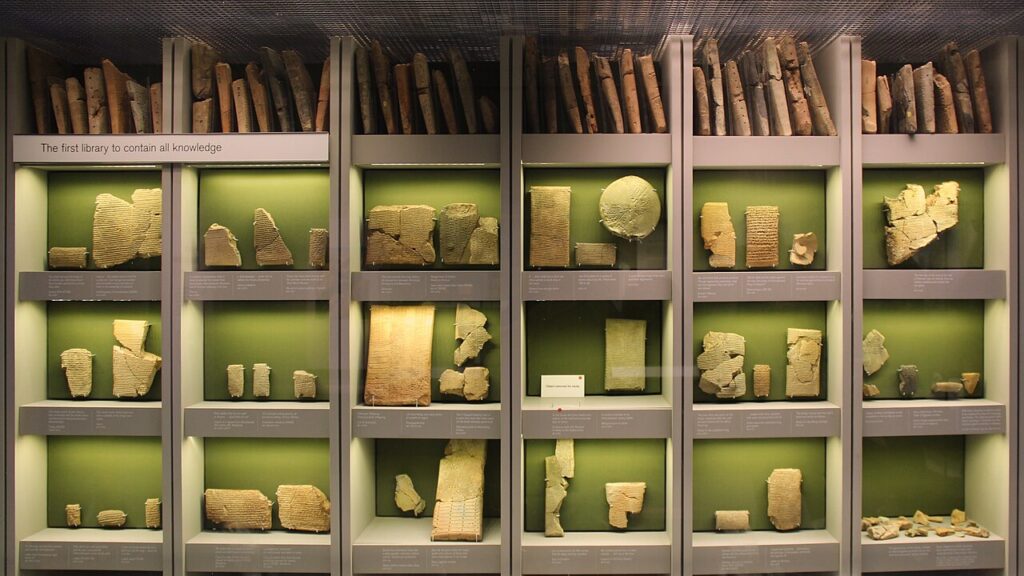
The oldest known systematically organized library in the world was built in the Assyrian capital of Nineveh, in what is now northern Iraq. King Ashurbanipal, who ruled from 668 to 627 BCE, assembled a collection of more than 30,000 clay tablets and fragments inscribed with cuneiform. The scope of the collection was remarkable for its time.
Ashurbanipal organized his library by subject, dedicating separate rooms to government, history, law, astronomy, and geography. Furthermore, he sent scribes across Mesopotamia to copy important texts and seized original materials from Babylon after his conquest of the city in 649 BCE. The library also housed the Epic of Gilgamesh, one of the oldest literary works in human history. Consequently, when a coalition of Babylonians, Scythians, and Medes destroyed Nineveh in 612 BCE, they set the palace ablaze. This fire inadvertently baked the clay tablets, preserving them for centuries.
The library of Alexandria
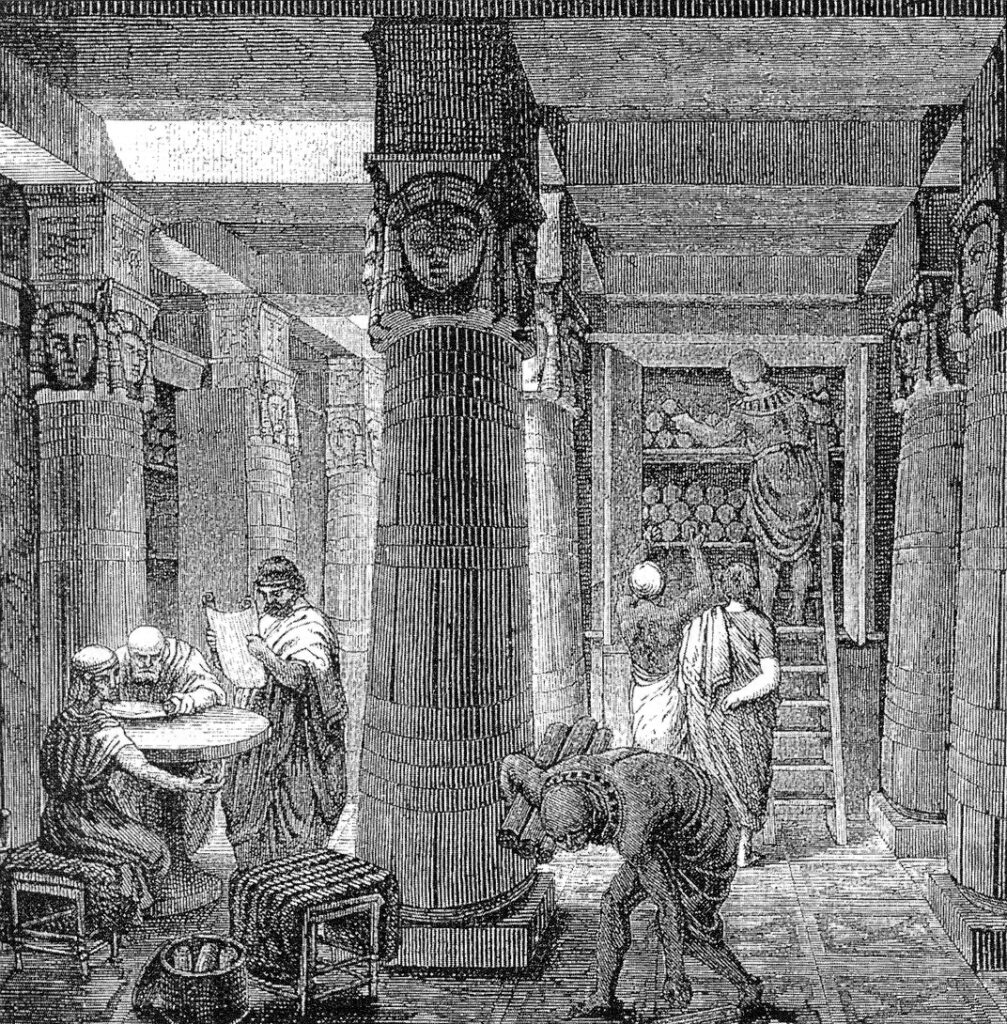
Perhaps the most famous library ever built was founded in Egypt following the death of Alexander the Great in 323 BCE. Ptolemy I Soter, the founder of the Ptolemaic dynasty, proposed the project as part of his vision for Alexandria as a great center of learning that would blend Greek and Egyptian culture. Construction and active collection began under his son, Ptolemy II Philadelphus, who ruled from 282 to 246 BCE.
The library grew aggressively. Under Ptolemy III Euergetes, who ruled from 246 to 221 BCE, books were seized from ships docked at Alexandria’s port, copied, and the originals were kept in the library’s stacks. Scholars from across the ancient world came to Alexandria to work, including mathematicians, astronomers, physicians, and poets. The library eventually held texts representing the intellectual output of Mesopotamia, Persia, Greece, Rome, and Egypt.
The institution was built adjacent to the Mouseion, a research center dedicated to the Muses, which functioned somewhat like a modern university. Together, the two institutions made Alexandria the intellectual capital of the Mediterranean world. The library continued to function for centuries and was closed in 642 CE when Arab forces conquered Egypt.
The library of Celsus
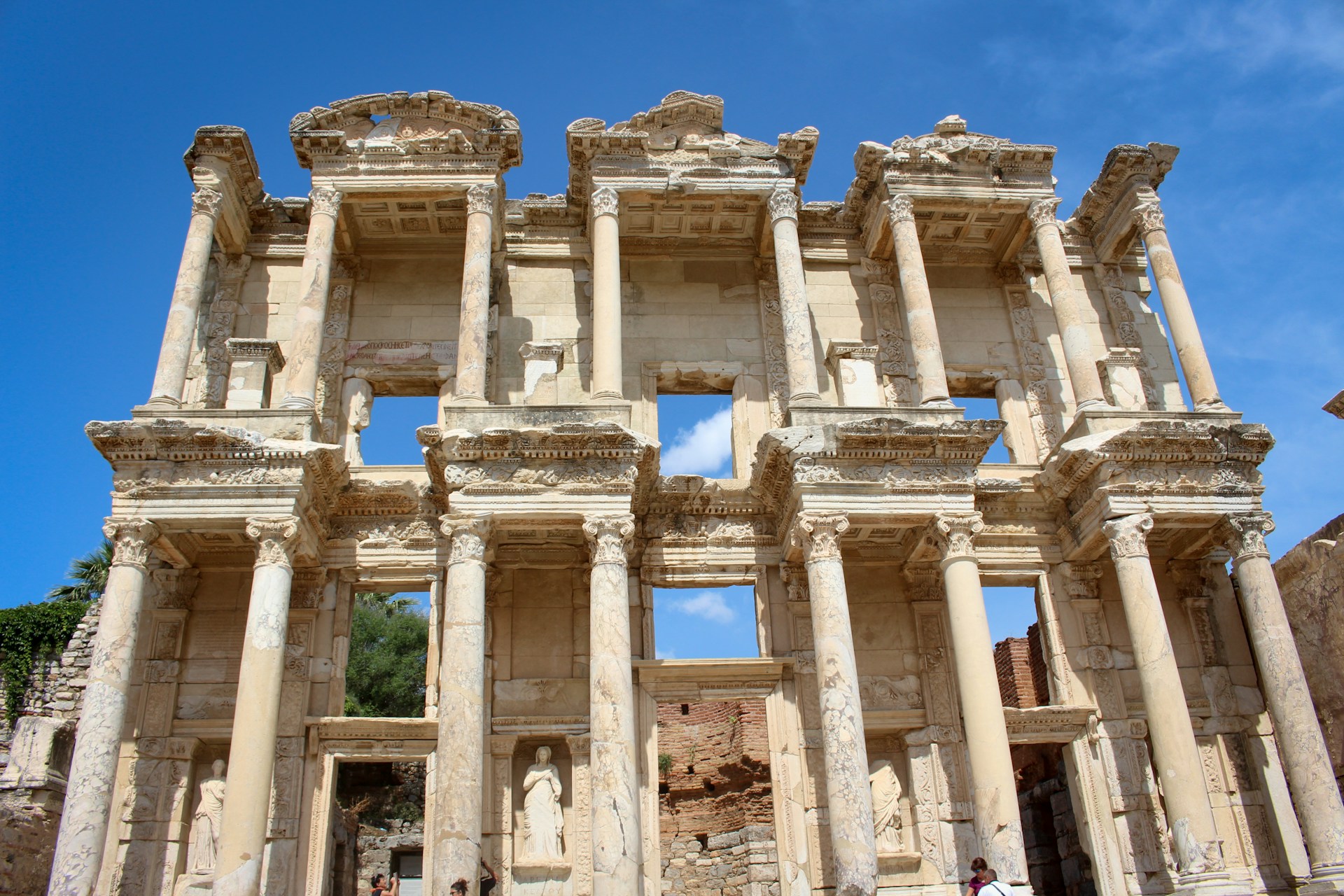
By the Roman period, libraries served as symbols of civic prestige. Among the most architecturally spectacular examples, the city of Ephesus hosted a library on the western coast of modern-day Turkey. Gaius Julius Aquila financed the construction of the Library of Celsus between approximately 114 and 135 CE to honor his father, Tiberius Julius Celsus Polemaeanus, a former Roman governor of Asia.
The building served a dual purpose: it housed over 12,000 scrolls and also functioned as a mausoleum for Celsus himself, whose sarcophagus was buried beneath the main reading room. The facade, which still stands today in partial reconstruction, featured columns on two levels and niches displaying allegorical statues representing wisdom, knowledge, intelligence, and virtue. The library stood as a monument to Roman ambition, communicating through architecture that Ephesus was a city of culture and learning
The origins of library development
Several key factors made the development of libraries possible. The most important was the invention of writing materials. Clay and the reed stylus in Mesopotamia, papyrus and reed pens in Egypt, and eventually wax tablets and the development of parchment in Roman made from animal skins allowed for even more durable records. These technologies dictated how books were stored and handled.
The social structure of ancient civilizations also played a vital role. The existence of a professional scribe class was necessary for the creation and maintenance of libraries. These individuals spent years learning complex writing systems. Moreover, the concentration of wealth in the hands of kings and wealthy citizens provided the necessary funding for large-scale projects. Without a stable government and a surplus of resources, these massive collections of knowledge could never have survived for centuries.
Libraries and the survival of the past
Ancient libraries played a central role in preserving knowledge within early societies, allowing administrative records, cultural traditions, and intellectual work to endure beyond a single generation. By recording and organizing information, they created continuity that supported the gradual development of ideas over time.
After many of these civilizations declined, their libraries became one of the main sources through which their worlds could still be understood. The clay tablets of Mesopotamia and the archives of Ebla survived as partial records of complex societies. From these materials, historians have reconstructed systems of governance, economic practices, and belief structures. These collections remain a vital link between the present and ancient cultures.