The machine that carved civilization: the invention of the plow
Before the plow, humans were locked in a cycle of gardening. We used digging sticks to poke holes in the earth, planting seeds one by one. It was slow and yielded just enough to survive. Around 3500 BCE, farmers in ancient Mesopotamia developed a solution to this problem.
The invention of the plow would become one of the most transformative inventions in human history, reshaping economies, enabling trade networks, and allowing civilizations to flourish. It changed the physics of food. Allowing us to tear into the earth, turn the soil, and unlock nutrients.
The Neolithic Problem: Why We Needed the Plow
The transition from hunting and gathering to farming wasn’t an immediate success. Early farmers faced a grueling reality: the earth is stubborn. Soil becomes compacted, weeds compete with crops for sunlight, and nutrients near the surface are quickly exhausted.
To feed a growing population, humans needed a way to aerate the soil on a massive scale. Aeration allows oxygen to reach the roots and helps the soil retain water. More importantly, farmers needed to bury weeds so they would decompose and act as fertilizer rather than competitors. The digging stick couldn’t do this. The “Ard,” or the scratch plow, was the first technological answer to this survival crisis.
The Birth of the Plow
The earliest plows, known as ards or scratch plows, emerged in Mesopotamia during the 4th millennium BCE. These simple devices consisted of a wooden beam, a pointed share designed to break the soil’s surface, and a handle for guidance. Unlike later versions, the ard didn’t turn soil over. It simply scratched a shallow furrow, which proved suitable for the hard, dry Mesopotamian earth.
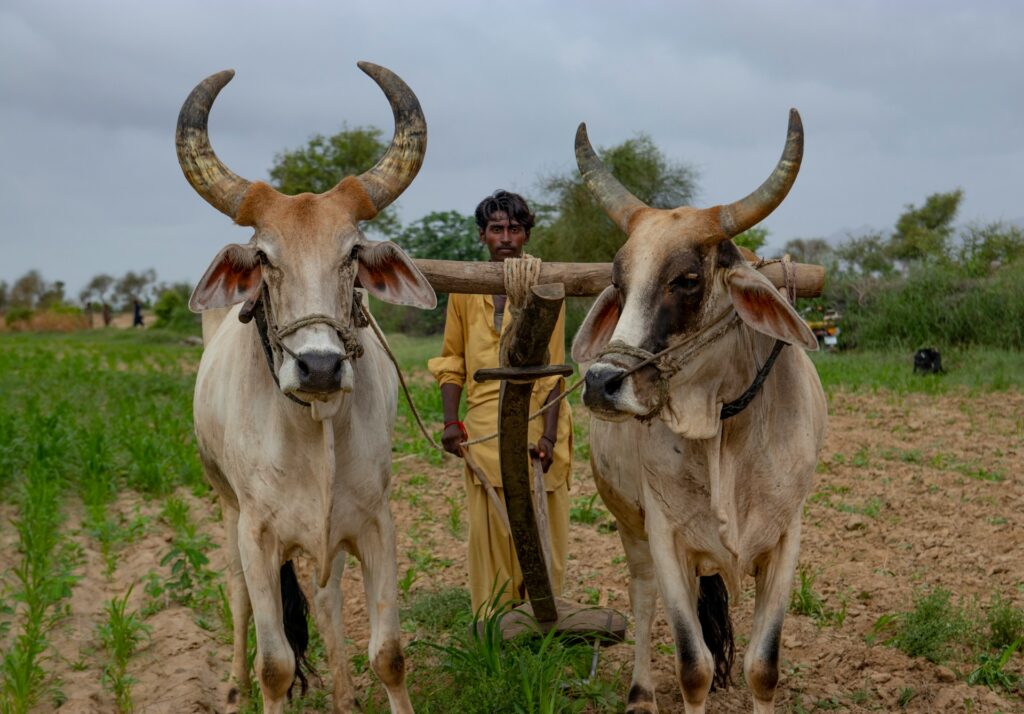
Initially, humans pulled these plows themselves, requiring enormous physical effort. The breakthrough came when farmers harnessed oxen to do the heavy work, multiplying efficiency and allowing cultivation of far larger fields. An ox is roughly ten times stronger than a human. By domesticating these animals and, crucially, inventing the yoke, humans were able to outsource the work of survival.
The yoke was a technological marvel in itself. It had to distribute the weight across the animal’s shoulders without choking it. Once the ox was hitched to the plow, the amount of land a single person could farm increased by 400%. This created the first energy revolution.
Woodworking, Metallurgy, and Animal Power
The plow’s invention required mastery of three critical technologies. Woodworking came first, craftspeople needed skills to shape beams, handles, and frames from timber. The earliest plows were entirely wooden, sometimes incorporating stone blades.
As populations grew and older fields became exhausted, farmers needed to break harder ground. This pressure drove metallurgical innovation. Iron components eventually replaced wooden parts, making plows more durable and effective.
An iron plowshare could cut through roots and heavy clay that would have shattered wood. This allowed civilization to expand into previously unfarmable territories, like the heavy, wet soils of Northern Europe and the dense river valleys of China. The progression from wood to iron to steel represented centuries of technological refinement, with each material allowing cultivation of increasingly difficult terrain.
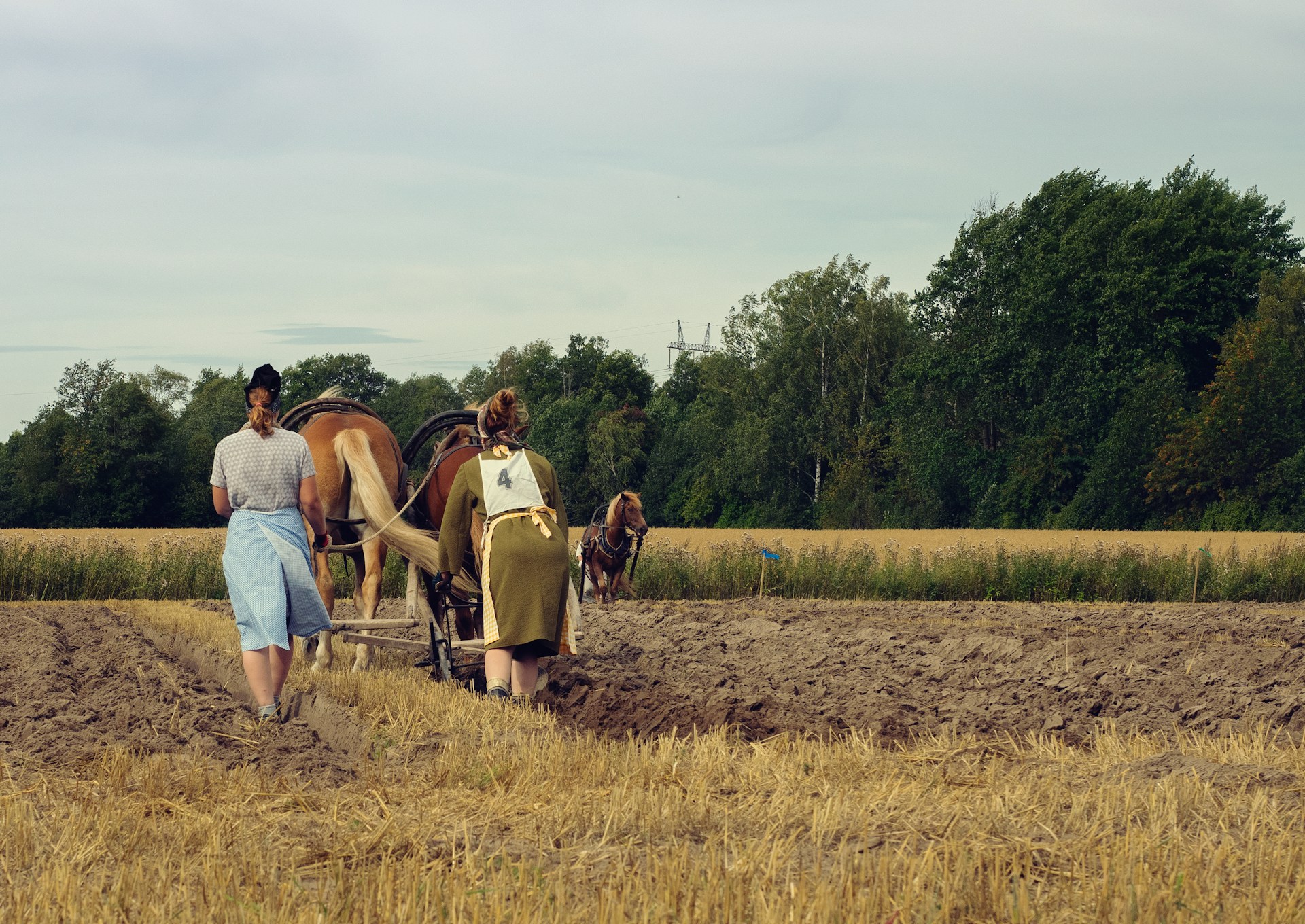
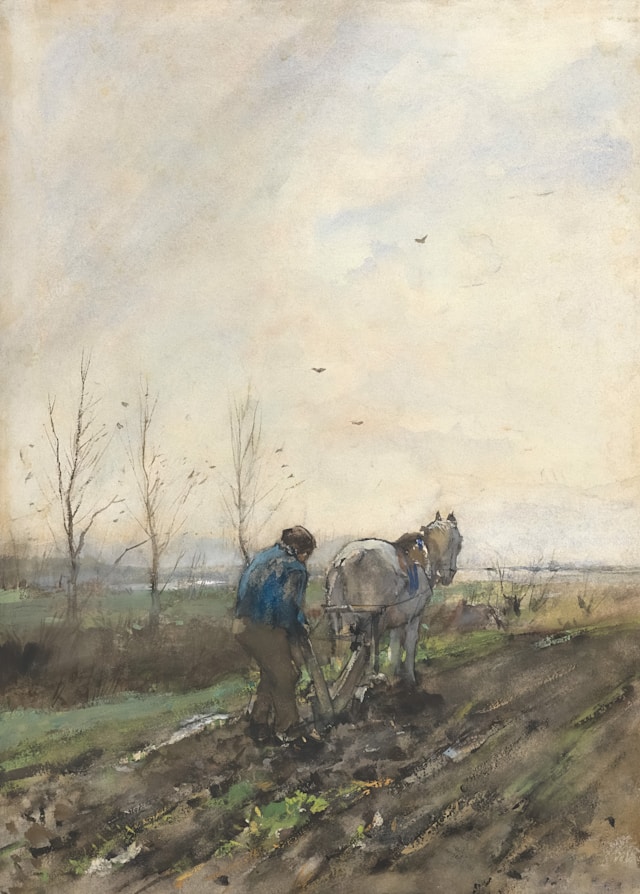
Animal power proved equally essential. Oxen were the first plow animals, strong enough to pull through resistant soil. Later, horses joined the workforce once proper harnesses were developed, working fields more rapidly than oxen though at higher maintenance costs. The shift from human to animal power allowed one farmer to accomplish what previously required many.
The Moldboard and the Power of the Wheel
In the East, Chinese inventors during the Han Dynasty (206 BCE – 220 CE) made a breakthrough that the West wouldn’t replicate for centuries: the moldboard.
Unlike the Ard, which just scratched a line, the moldboard plow had a curved plate. This plate didn’t just cut the soil; it lifted it and turned it over completely. This buried weeds and brought fresh, nutrient-rich soil to the top.
By the Middle Ages in Europe, the Heavy Plow emerged, incorporating wheels. The addition of wheels was a game-changer for ergonomics. It allowed the farmer to regulate the depth of the furrow more precisely and meant the plow didn’t have to be held up by pure human strength. The wheeled plow was heavy and expensive, requiring teams of eight oxen, which led to the “open-field system” where entire villages shared resources to manage a single plow.
The Economic Revolution
The plow’s impact extended far beyond individual fields. Agricultural surplus enabled by efficient plowing created the economic foundation for trade networks. Grain became the first global currency. Communities producing more food than they needed could exchange surplus for goods they couldn’t produce locally like metals, textiles and specialized tools.
This trade required infrastructure. Roads expanded to connect farming regions with markets and cities. Later, canals would further reduce transportation costs, but the fundamental pattern began with plow-generated surplus. Towns and cities grew as agricultural productivity increased, since fewer people needed to farm while more could pursue specialized occupations.
The heavy wheeled plow particularly drove economic growth in medieval Europe, contributing to population increases and urban expansion. In a direct sense, improved plowing technology nourished the feudal and religious establishments that defined the era. Social structures adapted to the technology, cooperation in sharing expensive plow teams stabilized communities. But, it also created new forms of interdependence between wealthy landowners and tenant farmers.
Convergence of conditions and the great shift
The plow’s invention required specific conditions to align. First, societies needed sedentary agriculture and sufficient population density to make intensive cultivation worthwhile. Second, they required woodworking and eventually metallurgical skills to craft durable implements. Third, animal domestication had to be advanced enough to provide reliable draft power.
It also changed the social structure of the family. It shifted the primary labor of the fields from a shared task to a male-dominated one in many cultures. This changed the “social DNA” of early societies, often leading to more patriarchal structures compared to the more egalitarian gathering societies. Furthermore, the expense of the plow created the first class distinctions. Those who owned the plow and the animals became the landed elite. Those who didn’t became the labor force.
The plow stands as a perfect example of how technological innovation emerges from necessity, builds on multiple prerequisite technologies, and then transforms the very societies that created it.