The history of wax in ancient civilizations
For thousands of years, humans have searched for materials to light their homes, seal their secrets, and create their art. Long before the invention of synthetic polymers or electricity, nature provided a miraculous substance: wax. This versatile material shaped the foundations of ancient industry and culture. From the temples of Egypt to the forums of Rome, wax served as a silent partner in the progress of human civilization.
Where It all began
The oldest confirmed evidence of human wax use dates to the 7th millennium BCE in Neolithic Anatolia, in what is today Turkey. A team of researchers from the University of Bristol analyzed over 6,400 prehistoric pottery sherds across Europe, the Middle East, and North Africa, searching for the unique chemical signature of beeswax. Their findings pointed to sites near Çatalhöyük, one of humanity’s oldest known settlements, as the epicenter of this discovery.
Over time, people learned how to harvest this material systematically. They realized that melting the honeycomb allowed them to separate the pure wax from impurities. Once the liquid cooled, it solidified into a durable block. This discovery marked the transition from seeing wax as a byproduct of honey to recognizing it as a primary resource for construction and preservation.
The science behind wax
Wax possesses unique chemical properties that distinguish it from other natural substances like oils and animal fats. While oils and fats are often greasy and remain liquid or soft at room temperature, wax behaves as a solid. It provides a high level of water resistance and acts as a natural adhesive. Chemically, waxes are long-chain fatty acid esters. This structure makes them much more stable than simple animal fats.
Furthermore, ancient civilizations discovered that wax could be harvested from various natural sources. While beeswax was the most common in the Mediterranean, other regions utilized different biological origins. In East Asia, for example, people harvested “white wax” from scale insects. In South America and parts of Africa, people found that certain plants secreted a waxy coating on their leaves to prevent dehydration.
The most important characteristic of all these waxes is their melting point. Wax remains stable in most climates but transforms into a workable liquid with relatively low heat. Additionally, wax burns much cleaner than animal tallow. Tallow candles, made from rendered animal fat, produced a smoky flame and a foul odor. Beeswax, in contrast, offered a bright light and a pleasant aroma. This physical superiority made it a premium commodity in antiquity.
The rise of the beekeeper (c. 2400 BCE)
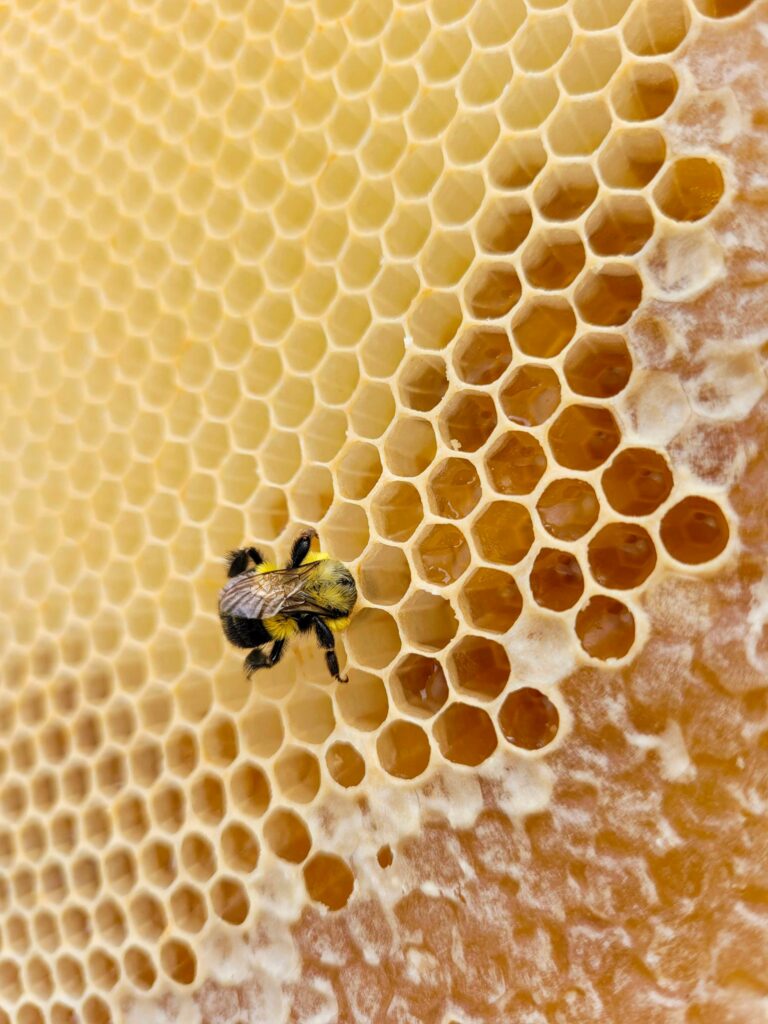
The shift from gathering wild wax to producing it required a deep understanding of animal behavior. Ancient peoples began to practice apiculture, or beekeeping, to ensure a steady supply of both honey and wax. The earliest documented evidence of organized beekeeping comes from the Sun Temple of Niuserre in Egypt, dated to approximately 2400 BCE. These reliefs show workers smoking hives and removing honeycombs.
Beekeepers created artificial environments for bees using hollowed-out logs, straw baskets, or clay pipes. They observed that a healthy colony could produce a surplus of wax beyond what was needed for honey storage. By protecting the bees from predators and providing them with specific flowering plants, ancient farmers maximized their yield. This early form of animal husbandry turned the honeybee into one of the most important industrial species of the ancient world.
The civilizations that mastered it
The ancient Egyptians were the first great wax civilization. By around 2000 BCE, beeswax appeared in Egyptian medical texts, cited in 32 separate prescriptions recorded in a papyrus from approximately 1550 BCE. They used it to preserve wig curls, waterproof boats, seal coffins during mummification, and bind bandages as a medical adhesive.
The Mesopotamians followed closely. In the Ur III period, wax writing tablets appeared as early administrative tools. The Persians and Assyrians also adopted it for embalming, a practice that spread across the ancient Near East.
Greeks and Romans elevated wax into both commerce and culture. Rome famously demanded beeswax as tribute when it conquered Corsica in 181 BCE. Beeswax candles burned in temples, and wax tablets became the standard portable writing medium throughout the Greco-Roman world, a kind of ancient notebook, infinitely erasable with a flat stylus end.
Uses in different domains
In the world of ancient commerce, wax functioned as a primary security device. Around 1500 BCE, traders in the Mediterranean began using wax seals to protect the integrity of scrolls and shipments. A wax seal provided a unique signet mark that proved a document had not been opened. Consequently, trust in international trade grew as a direct result of this simple material.
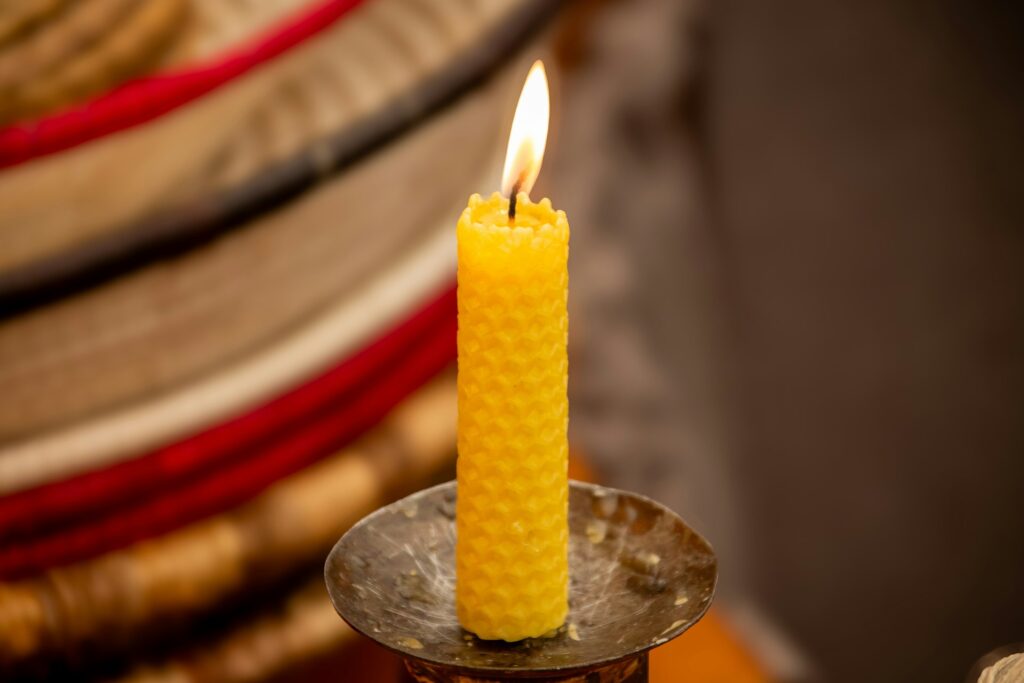
Religion also relied heavily on wax for both ritual and preservation. In Egypt, priests used wax to seal the internal organs of the deceased within canopic jars. By the New Kingdom (c. 1550–1070 BCE), wax was also used to create protective amulets. The Romans later used wax to create “imagines.” These were lifelike masks of ancestors displayed during funerals to honor the family lineage. Additionally, the steady, golden light of a beeswax candle symbolized purity in many ancient temples.
In the realm of hygiene and medicine, wax served as a vital base. Ancient texts like the Ebers Papyrus, written around 1550 BCE, describe wax as an ingredient in ointments for treating wounds. It acted as a moisture barrier, protecting the skin from infection. Furthermore, wax was a key ingredient in early forms of cosmetics and hair removal. These grooming practices were common among the elite in Egypt and Rome.
The metallurgy revolution: lost-wax casting
Perhaps the most consequential use of wax in antiquity was lost-wax casting, known in French as cire perdue. The technique dates to the Chalcolithic period, before 4000 BCE, and likely originated across multiple regions independently.
The process worked like this: an artisan would sculpt a detailed object in wax, coat it in clay, then fire the clay mold. The wax melted and drained away, leaving a perfect cavity. Molten bronze, gold, or silver was then poured in. When the clay was broken apart, a flawless metal object emerged, with every curve and detail the wax had held.
This technique required several prior inventions: controlled fire, pottery and clay working, knowledge of metal smelting, and the ability to harvest and purify wax in quantity. Without each of those foundations already in place, cire perdue could never have happened. The Egyptians were practicing it by the mid-3rd millennium BCE; Greeks, Etruscans, Mesopotamians, and Indians all developed versions of the technique.
The famous bronze Buddha at the Tōdai-ji monastery in Nara, cast between 743 and 749 CE, reportedly used seven tons of wax in its creation. That single fact captures how ancient this technology was and how far it traveled.
Why wax conquered the ancient world
Specific social and technological conditions made the widespread use of wax possible. Urbanization created a concentrated demand for lighting and record-keeping. As cities grew, the need for efficient trade and legal systems turned wax seals and writing tablets into indispensable tools.
Moreover, stable trade routes allowed merchants to transport wax from rural beekeeping regions to great urban centers. Labor specialization also accelerated this progress. Specifically, professional beekeepers, candle makers, and bronze casters refined wax-processing knowledge over generations.
Wax was a foundational technology that enabled ancient humans to communicate, create art, and worship. Even today, the history of wax reminds us of our long-standing partnership with the natural world.