The history of dyes: from prehistoric pigments to ancient textile mastery
The world of the ancient past was far from gray. A desire to imbue objects, bodies, and textiles with color appears as a fundamental human impulse, emerging alongside the earliest expressions of symbolic thought.
Long before laboratories or synthetic pigments, human beings were already masters of color. The history of dyes reaches back hundreds of thousands of years, stretching from prehistoric cave walls to the robes of Roman emperors.
The oldest marks of color
The earliest evidence of pigment use comes from Africa. At Blombos Cave in South Africa, archaeologists have uncovered more than 8,000 pieces of ochre dating to between 75,000 and 100,000 BC, many of them shaped into crude crayons. Similar traces of ochre appear in Kenya, Zambia, and Ethiopia, suggesting that pigment use was a widespread feature of Lower Paleolithic culture since at least 300,000 BC.
Ochre is an iron-rich mineral, and its red and yellow tones come from iron oxides, specifically hematite. Early humans mixed it with animal fat or water to paint cave walls, producing the famous images at Lascaux in France (around 16,000 to 14,000 BC), the Cueva de los Manos in Argentina (around 11,000 to 7,500 BC), and the Bhimbetka shelters in India. Alongside ochre, charcoal served as a black pigment, and limestone produced white tones. Together, these substances formed the foundation of all future color technology.
The chemical foundations of dyes
Understanding the difference between a pigment and a dye is essential for grasping ancient technology. Pigments are insoluble particles that sit on top of a surface. Dyes are substances that dissolve in a liquid and bond chemically to the fibers of a material. The key challenge in dyeing was not coloring a fiber, but making the color stay.
Furthermore, the chemical process of dyeing requires a bridge between the fiber and the color molecule. This bridge is known as a mordant. Ancient peoples discovered that certain minerals, such as alum or iron, could fix a dye to a fabric so it would not wash away. This discovery was a major chemical breakthrough for early chemistry. We still use these same principles today in the modern textile industry. While synthetic dyes are now common, the molecular bonding of natural tannins and flavonoids remains the foundation of many artisanal dyeing techniques.
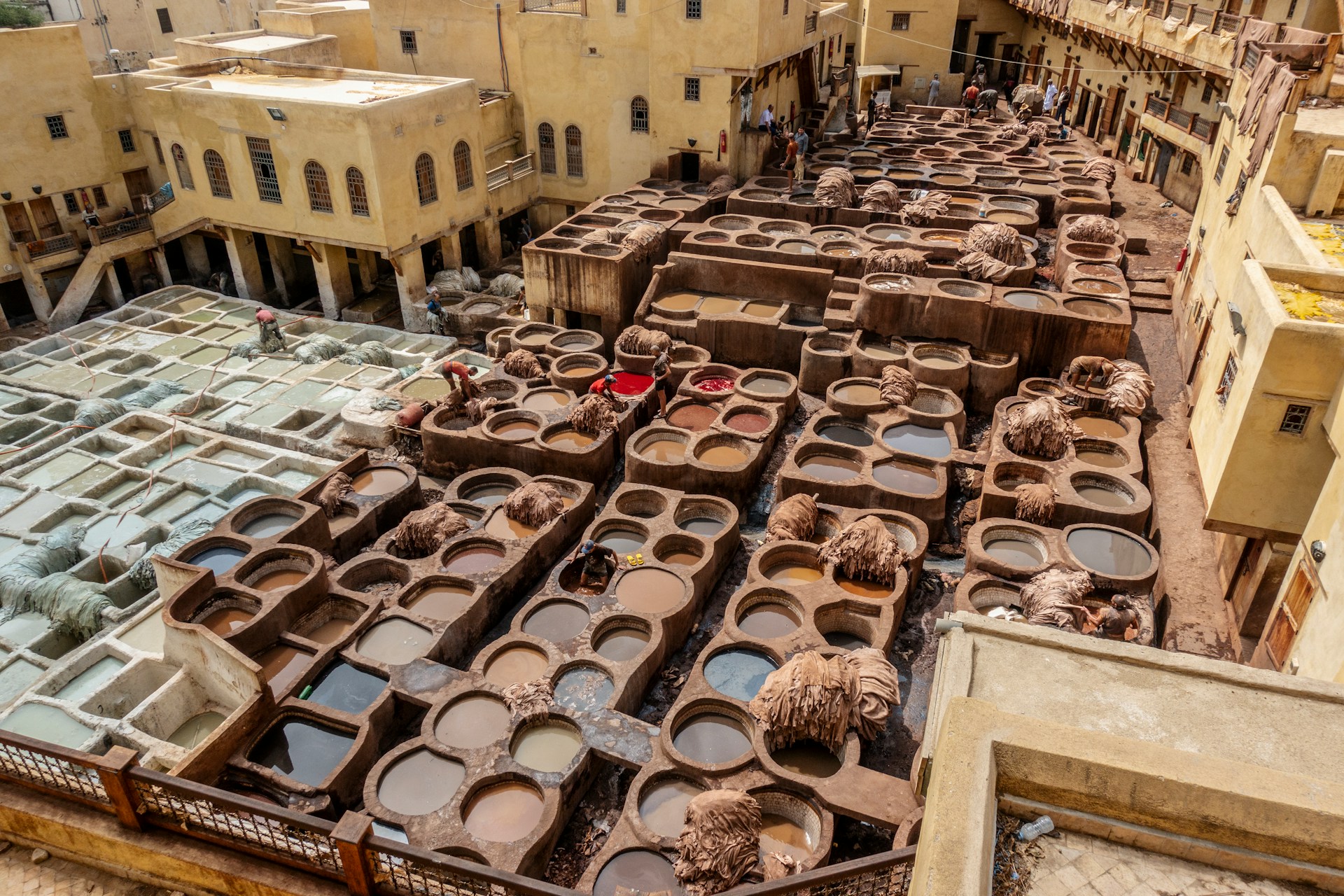
Indigo, one of the most prized dyes of antiquity, operates on a different chemical principle. The indigo plant contains indican, a colorless, water-soluble compound. Through a process of fermentation and oxidation, the indican converts into insoluble indigotin, the deep blue molecule that famously dyes jeans today. This process, which required careful vat management, was mastered independently in several regions, with evidence of indigo use dating to around 2500 BCE in Mesopotamia.
From skin to cloth
The step from painting walls to coloring cloth happened gradually, during the Neolithic period. Archaeological evidence from the Dzudzuana Cave in the Caucasus region of Georgia reveals 30,000-year-old flax fibers dyed in yellow, red, blue, violet, black, brown, green, and khaki. Around 10,000 BCE, further evidence from the Timna Valley in southern Israel confirms textile dyeing practices at copper mining sites.
By roughly 3,000 BCE, dyeing had become deeply integrated with spinning and weaving across the Near East, Egypt, and South Asia. At the Indus Valley sites of Mohenjo-daro and Harappa, fragments of red cotton cloth dated to 2600 BCE confirm that mordanting techniques and natural dye production were already part of organized urban craft. Meanwhile, in China, historical records suggest that dyes extracted from insects, tree barks, and plants were in use approximately 5,000 years ago.
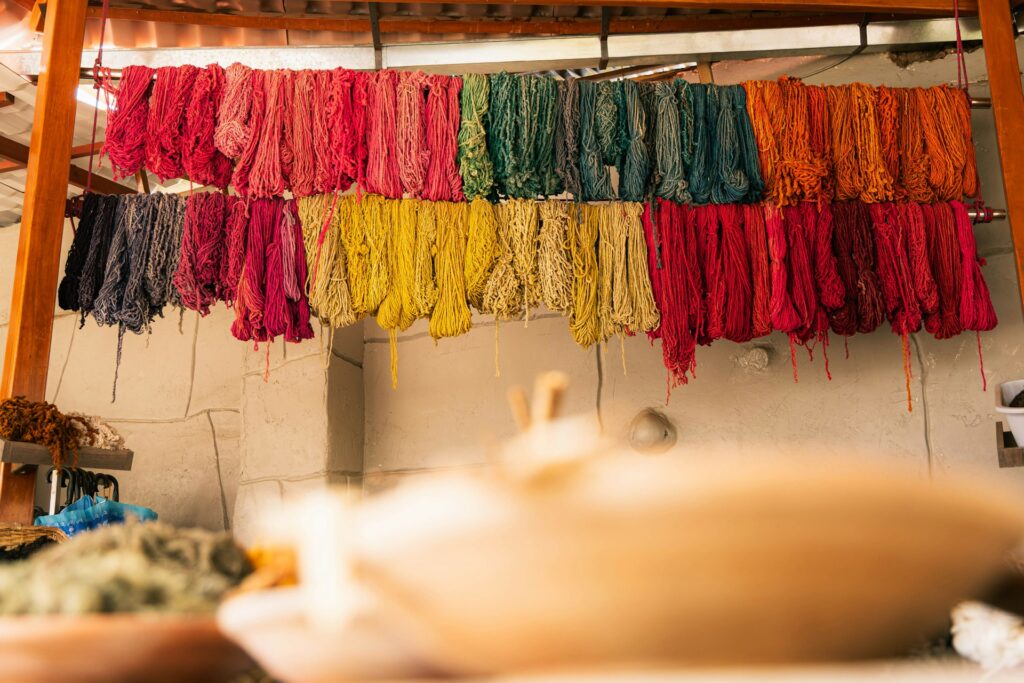
During this era, people began to cultivate specific plants for their coloring properties. Inhabitants of the Middle East and Europe discovered that the roots of the madder plant produced a vibrant red. Simultaneously, they found that weld provided a bright yellow. By layering these colors, ancient weavers could produce a wide variety of shades. These early techniques required precise temperature control and specific water acidity. Therefore, the dyer became one of the first specialized craftsmen in human history.
The global journey of natural pigments
The invention of dyeing emerged independently in various societies, each drawing on locally available resources. In East Asia, the use of Polygonum tinctorium, a source of indigo, appeared in China during the Shang dynasty, around 1600 BCE. The Japanese developed highly refined techniques for indigo dyeing, known as aizome, which became deeply embedded in their textile traditions.
In South America, the Andean civilizations achieved remarkable sophistication in dyeing. The Paracas culture, flourishing between 800 and 100 BCE, produced textiles of extraordinary complexity. Their dyers used cochineal, a red dye derived from insects that feed on prickly pear cacti, as well as indigo from local plants. The combination of these dyes with advanced weaving techniques made Andean textiles among the most prized goods in pre-Columbian trade networks.
The humble power of onion skins and organic materials
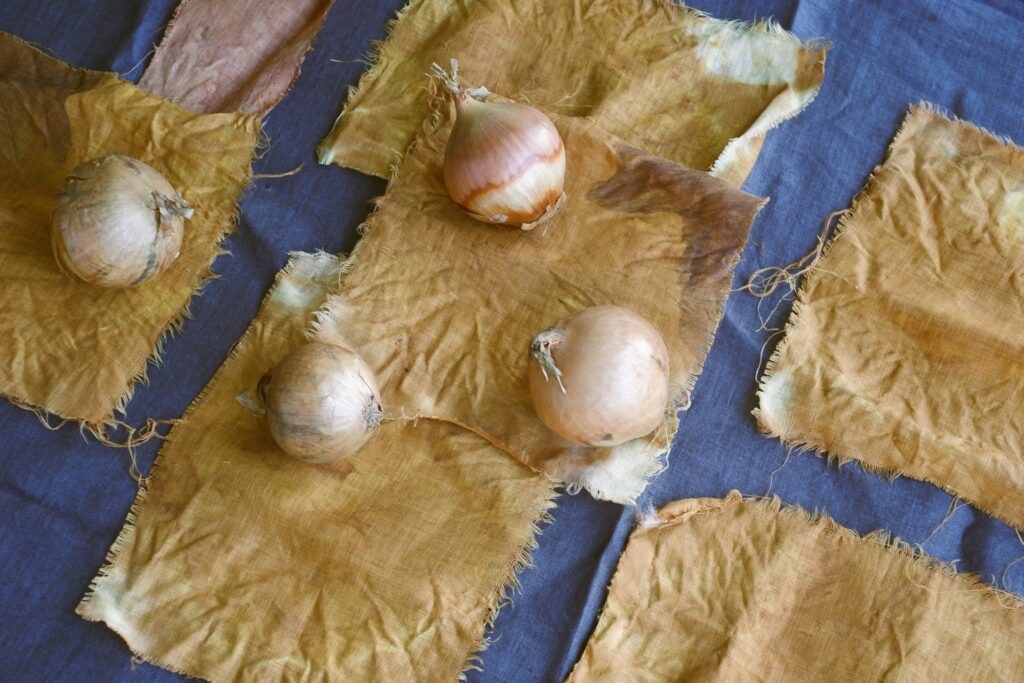
One of the most accessible forms of ancient dyeing involved common food waste and local vegetation. Onion skins are an excellent example of a natural dye source that has been used for millennia. The skins contain high concentrations of flavonoids, which produce colors ranging from soft gold to deep burnt orange. Because onion skins are rich in natural tannins, they often require very little mordant to adhere to wool.
Furthermore, many other kitchen staples served as dyes in antiquity. Turmeric provided a bright yellow in India, while walnut husks created rich browns in Europe. These materials allowed common people to add color to their lives without needing expensive imports. We still use onion skins today in traditional crafts because they are non-toxic and environmentally friendly. This continuity demonstrates that ancient knowledge remains relevant in our modern search for sustainable production methods.
Key factors enabling innovation
The creation of dyes required several supporting technologies. The first was the mortar and pestle, which allowed for the fine grinding of minerals and roots. Without a fine powder, the color would be patchy and inconsistent. Another critical technology was the development of pottery and large vats. These containers allowed for the fermentation of plant materials, which is a necessary step for releasing certain colors like indigo. Additionally, the mastery of fire was crucial for the dyeing process. Many dyes require the liquid to be held at a specific temperature for several hours to ensure the chemical bond occurs.
From the demand side, the emergence of elite classes created the necessity for luxury goods, driving innovation in color production. Rulers and religious authorities sought distinctive colors that would signify their status, providing patronage for dyers and encouraging experimentation.
The development of writing and record-keeping allowed for the transmission of dyeing knowledge across generations. Mesopotamian cuneiform tablets contain references to dyeing processes. Egyptian papyri detail recipes for dye baths. These written records preserved techniques that might otherwise have been lost, creating a foundation for continuous improvement.
Religion, trade and the social impact of color
Color was deeply tied to social status and religious belief. For example, the Phoenicians became famous around 1600 BCE for their production of Tyrian purple. This dye was extracted from the mucus of sea snails and was incredibly expensive to produce. Around 12,000 snails were needed to produce just 0.05 ounces of dye, enough to color only the trim of a single garment.
Eventually, Rome adopted Tyrian purple as the exclusive marker of imperial authority, and by the 1st century AD, wearing a full robe dyed in purple without imperial permission was punishable by law. Such was the political power of a color.
Moreover, color played a vital role in construction and architecture. The Egyptians used blue frit, a synthetic pigment made from copper and silica, to decorate their temples and tombs. This blue represented the heavens and the Nile, connecting the physical building to the spiritual world. The trade of these pigments also drove early globalization. The Silk Road was a route for the exchange of indigo, saffron, and lapis lazuli. Color was a high-value commodity that funded empires and encouraged cross-cultural contact.
The legacy of natural dyes
Remarkably, many of the techniques developed in prehistory and antiquity remain in use today. Natural dyeing has experienced a revival among artisans and textile enthusiasts. Onion skins continue to provide warm yellows, just as they did for ancient dyers. Indigo fermentation vats operate on principles unchanged for millennia. Madder root still yields its distinctive reds.
The chemical insights that ancient dyers discovered through patient observation now inform modern dye chemistry. The principles of mordanting, the importance of pH in dye baths, and the use of reducing agents for vat dyes all trace their origins to ancient practices.
The story of dyes in prehistory and antiquity reveals a fundamental human drive to bring color into the world. From the ochre workshops of early Homo sapiens to the sophisticated dye industries of Rome and Han China, the pursuit of color pushed forward technologies, created trade networks, and gave visual form to the deepest human beliefs about power, divinity, and beauty.