The evolution of roads and bridges
Roads and bridges rank among humanity’s oldest engineering achievements. They reshaped how societies moved, traded, and expanded their reach. What began as animal migration paths followed by nomadic tribes gradually evolved into vast, sophisticated networks. Systems that enabled empires to rise, territories to be controlled, and entire continents to become connected.
From footpaths to trade routes
In the prehistoric era, roads were reactive. They followed the topography of the land, snaking around hills and avoiding marshes. These routes served immediate survival needs, connecting water sources, hunting grounds, and seasonal camps. These paths were temporary and shifted with environmental changes. There was no concept of permanence or standardization, just functional trails that communities maintained through continuous use.
The earliest roads emerged around 4000 BCE in Mesopotamia, where repeated human and animal movement naturally compressed earth into recognizable pathways. These weren’t engineered structures but organic trails that grew from necessity.
The rise of engineered infrastructure
The shift to ancient and classical roads was driven by a fundamental change in human organization: the rise of the state. Empires like the Romans, the Persians, and the Qin Dynasty in China realized that to hold territory. One had to be able to move information and armies faster than a rebellion could form.
Around 312 BC, Romans constructed the Appian Way, featuring durable stone construction and precise engineering that would set standards for millennia. This marked a fundamental shift from paths that emerged naturally to roads that were deliberately planned and built.
The difference between prehistoric and classical roads was profound. While prehistoric tracks were simple compressed earth following natural contours, ancient roads involved excavation, drainage systems, multiple material layers, and strategic planning. Classical roads connected cities, facilitated military movement, and enabled empire administration in ways prehistoric pathways never could.
The peoples that mastered roads
The Romans became legendary for their road-building prowess, creating over 400,000 kilometers of roads across their empire. Their roads featured multiple layers: large stones for foundation, smaller stones for drainage, gravel, and paved surfaces. Ensuring durability that allowed some Roman roads to survive two thousand years.
China’s road networks rivaled Rome’s in scope and ambition. The Qin Dynasty established a nationwide road system to consolidate power and move armies efficiently. The Chidao, or “Fast Riding Road,” served as the backbone of domestic transport, stretching about fifty feet wide and lined with trees. Unlike Roman roads with their multiple layers, Chinese roads were simpler, featuring paved stones only on key routes but compensating with impressive width and strategic placement.
In Mesopotamia and Egypt, early civilizations built roads using compacted earth and gravel, creating vital trade networks between cities. The Indus Valley civilization similarly developed road systems that facilitated commerce and urban planning. Though these lacked the engineering sophistication of later Roman construction.

The architecture of bridges
Bridges presented even greater engineering challenges than roads. Romans pioneered techniques that would define bridge construction for centuries. They began with timber pilings driven into riverbeds, then developed watertight cofferdams, temporary wooden enclosures that allowed workers to redirect water and lay stone foundations in dry conditions.
The Sant’Angelo Bridge in Rome, standing on cofferdam foundations built in the Tiber River over 1,800 years ago, demonstrates the durability of these techniques. Romans preferred circular arch forms, which allowed spans much longer than stone beams and greater permanence than wood. Their bridges featured spandrels, cornices, and dolphin imagery, transforming functional structures into architectural statements.
Continental variations
Road and bridge development varied dramatically across continents, shaped by geography, materials, and cultural priorities. Roman roads in Europe emphasized military efficiency and empire connectivity, built straight and solid to move legions quickly across vast territories.
Chinese road systems adapted to challenging mountain terrain with remarkable innovation. The plank roads crossing the Qinling Mountains involved carving paths into mountainsides, with square wooden beams and boards forming suspended pathways along cliff faces. These treacherous routes, like the Shudao, were so difficult that Tang poet Li Bai compared traveling them to climbing to the sky. Some sections extended over 600 kilometers from Chang’an to Chengdu, maintained and expanded through multiple dynasties.
Middle Eastern roads in Mesopotamia and Egypt focused on facilitating trade between urban centers, using locally available materials like compacted earth suitable for arid climates. The absence of heavy rainfall made these simpler construction methods viable, though wet seasons could render roads nearly impassable.
In South America, the Inca Empire created the Qhapaq Ñan, a 25,000-mile road network that traversed the Andes. What makes this extraordinary is that the Inca did not use the wheel. Their roads were designed for foot traffic and llamas, featuring steep stairways and high-altitude tunnels that would be impossible for a cart. To cross massive canyons, they engineered hanging rope bridges made of woven grass, some spanning over 150 feet, which were replaced annually in a communal ritual.
How antiquity roads still exists
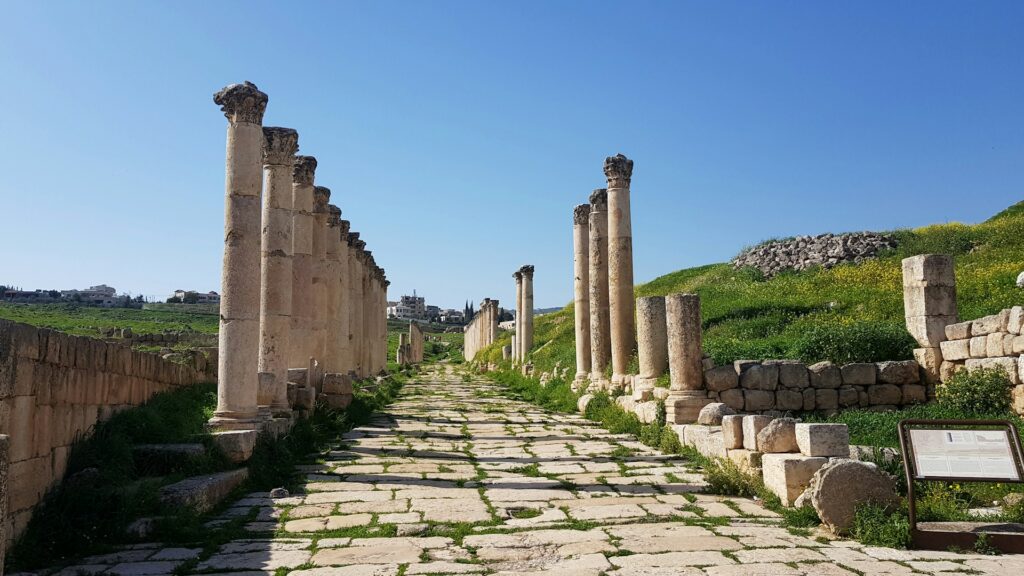
The reason we can still walk on Roman roads today is a sophisticated understanding of materials and physics. Several key technologies allowed these structures to last for millennia.
The Roman Arch and the Key Stone
Before the arch, bridges used “post and lintel” construction, two vertical posts and a flat horizontal beam. This limited the span and the weight capacity. The Roman arch distributed weight outward toward the abutments. The “key stone” at the top of the arch locked the structure in place using gravity. As more weight was placed on the bridge, the stones pressed tighter together, making the structure stronger rather than weaker.
Hydraulic Concrete (Pozzolana)
The Romans discovered a magic ingredient: volcanic ash from the Pozzuoli region. When mixed with lime and water, it created a concrete that could set underwater and was incredibly resistant to erosion. This allowed them to build bridge piers in the middle of rushing rivers, creating foundations that essentially turned into artificial rock over time.
The Multi-Layered Stratum
A Roman road was an engineering marvel beneath the surface. It typically consisted of four layers:
- Statumen: Large, heavy stones to provide a firm base.
- Rudus: A layer of rubble and lime to provide cushioning and further stability.
- Nucleus: Fine gravel and sand mixed with lime.
- Pavimentum: The top layer of large, hexagonal basalt or flint stones, fitted together with such precision that a knife blade could barely fit between them.
The Camber and Drainage
The greatest enemy of any road is water. Ancient engineers solved this by giving roads a “camber”, a slight curve where the center is higher than the edges. This forced rainwater to run off into side ditches (fossae). By keeping the foundation dry, they prevented the freeze-thaw cycles that shatter modern asphalt.
The Foundation of the Modern World
Ancient roads and bridges fundamentally altered human civilization, enabling trade networks, military campaigns, and cultural exchange on unprecedented scales. The engineering principles developed by Romans, Chinese, and other ancient societies, layered construction, cofferdam foundations, arch structures, and standardized measurements, demonstrate remarkable sophistication that modern engineers still replicate.
These ancient structures dictated the location of our modern cities. London, Paris, and Istanbul all exist where they do because ancient engineers found the best place to bridge a river or intersect a trade route. We are still driving on the ghosts of Roman surveys, utilizing the same mountain passes cleared by the Inca, and crossing rivers at the exact points deemed optimal by architects who lived two thousand years ago. The durability of their technology ensured that even as empires crumbled, the connections they forged remained.