How ancient engineers lifted stones for pyramids and monuments
The scale of ancient monuments remains a marvel for modern observers. Builders in Egypt and Mesopotamia handled stones weighing dozens of tons with incredible precision. They achieved these feats without the internal combustion engine or modern hydraulics. Instead, they relied on a sophisticated understanding of mechanical advantage and physics.
These early engineers developed a suite of tools that transformed the landscape of the ancient world. They built temples, tombs, and aqueducts that still stand today as evidence of their ingenuity. Their methods combined physical labor with clever machine design to overcome the limits of human strength.
Early techniques and the power of the ramp
Around 2550 BCE, the Great Pyramid of Giza rose from the desert sands. The workers used wooden sledges to transport limestone blocks across the construction site. They poured water or oil on the sand in front of the sledges to reduce friction. This simple act made the heavy loads slide with much less effort from the labor teams.
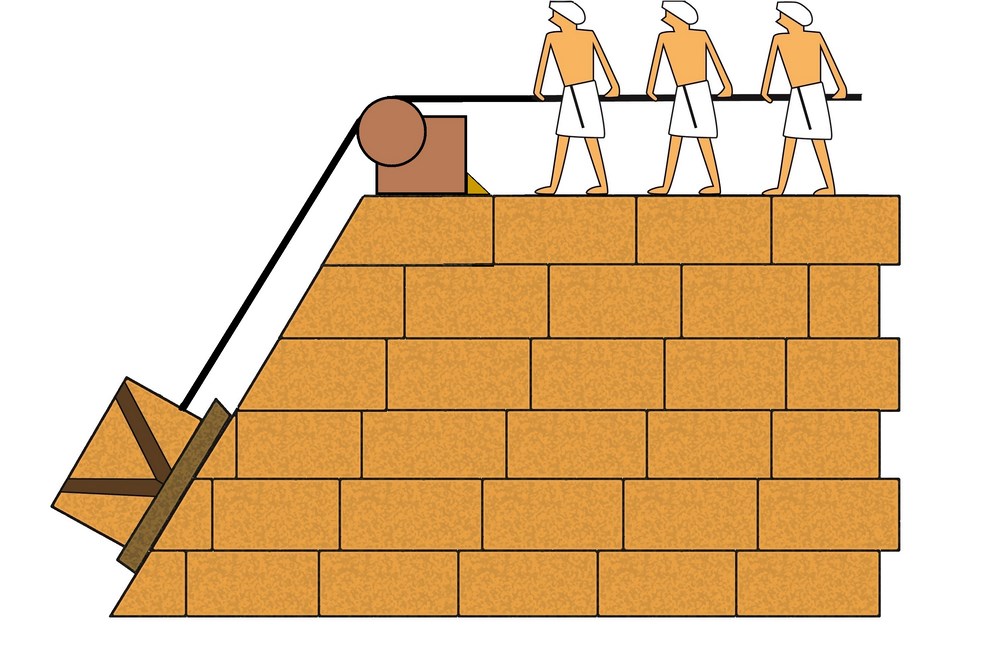
Ramps provided the necessary path to elevate these materials to great heights. As the structure grew, the ramps became longer or spiraled around the core of the pyramid. This method allowed thousands of men to combine their physical strength effectively. It represents one of the earliest systematic applications of the inclined plane in history.
During this era, builders also utilized the Egyptian pulley. This was a simple wooden block with a deep groove carved into the surface. It functioned as a guide for heavy ropes rather than a modern rotating wheel. This device allowed workers to change the direction of a pull without fraying the rope. It was a crucial step toward more complex mechanical systems.
The introduction of the lever and the wedge
Simple tools like the wedge and the lever provided the foundation for early construction. Around 3000 BCE, the builders of Stonehenge in Britain moved megaliths across vast distances. They likely used wooden wedges to split massive stones from quarries with high accuracy. By driving wooden wedges into cracks and soaking them with water, the expansion of the wood forced the rock apart.
The workers at Stonehenge also utilized the lever to position their stones. They used long wooden beams to pry the heavy blocks into upright positions. This method relied on basic physics to multiply the force applied by the workers. It allowed relatively small groups of people to manage stones that weighed several tons.
Archimedes of Syracuse later formalized the mathematics of the lever around 250 BCE. He famously claimed he could move the entire earth if he had a place to stand. A long wooden beam and a sturdy fulcrum allowed a single person to lift weights that would otherwise require a dozen men. His work turned an ancient practice into a precise science for future engineers.
The physics of wheels and axles
Transportation of materials over long distances required the invention of the wheel. While the wheel appeared around 3500 BCE in Mesopotamia, its application in heavy lifting evolved slowly over time. The wheel and axle assembly functions as a continuous lever that rotates around a center point.
When a small force is applied to the outer rim of a large wheel, it creates a much larger force at the axle. This is the same principle found in the design of a water well. A person turns a handle on a large radius to lift a heavy bucket of water with minimal effort. This rotation provides a mechanical advantage that is essential for moving large weights.
Builders used these devices to pull heavy blocks across rugged terrain and up steep inclines. The transition from simple rollers to fixed axles allowed for more controlled and sustainable movement of cargo. Consequently, the civilizations of Mesopotamia could transport building materials over much larger distances than before.

Greek contribution and the birth of the crane
By the 6th century BCE, Greek builders began to move away from the use of massive ramps. They sought more efficient ways to build tall temples like the Parthenon in Athens. They developed the earliest cranes during this period to lift heavy stones vertically. These machines used a combination of pulleys and winches to multiply human power.
A single pulley allowed a worker to change the direction of a pull, which was helpful for stability. A compound pulley system multiplied the lifting power significantly by distributing the weight across multiple ropes. The Greeks could lift stones with high precision and place them exactly where they were needed.
This innovation reduced the need for massive earthen ramps. It also allowed for more delicate architectural designs because the lifting force was concentrated and controlled. The Greeks documented these machines in their technical writings, which influenced engineering for centuries to come.
The roman crane and the treadwheel
Roman engineers took Greek designs and expanded them for massive imperial projects throughout the 1st century BCE. Vitruvius was a famous Roman engineer who documented the construction of the polyspastos. This crane featured a system of three or five pulleys that allowed for immense lifting capacity.
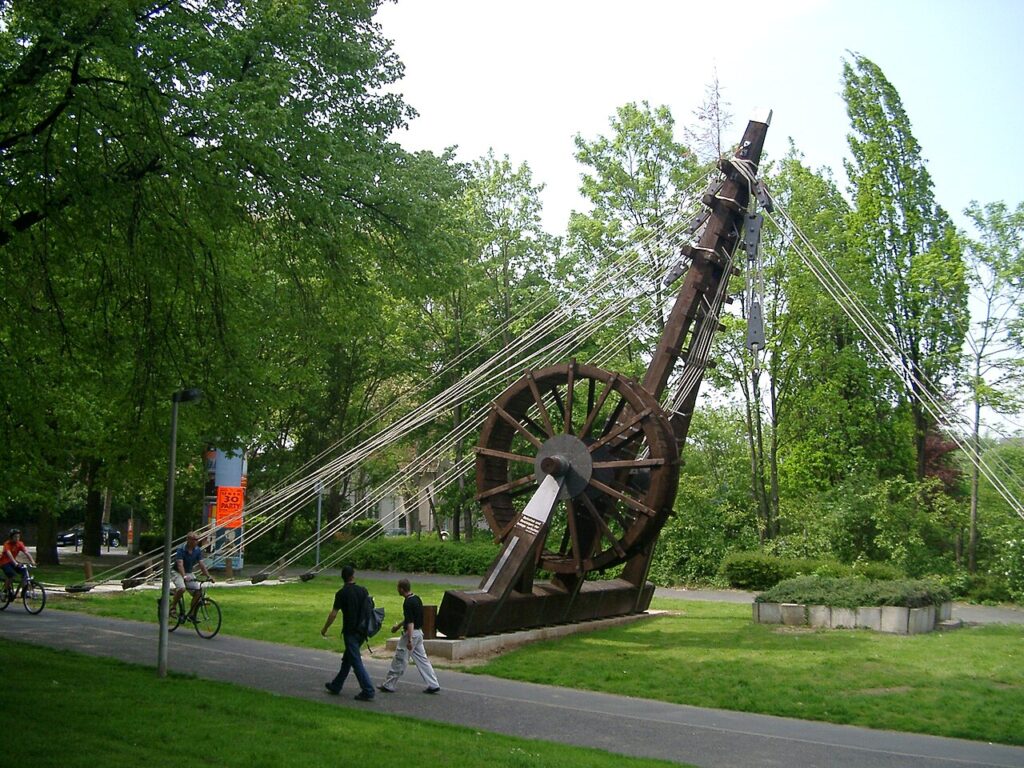
For the heaviest tasks, the Romans incorporated the treadwheel into their crane designs. This was a large wooden drum where workers walked inside to provide power. The large diameter of the drum provided an incredible mechanical advantage to the system. The power of a single person walking inside a treadwheel could lift several tons of stone.
This technology allowed for the construction of the Colosseum and the massive aqueducts that spanned the Roman Empire. Roman cranes were often equipped with multiple pulleys to further increase their strength. These machines represented the peak of ancient lifting technology and remained in use through the medieval period.
The role of gears and mechanical systems
The development of gears was a major leap in ancient engineering and machine design. While we often associate gears with clocks, they were vital for ancient lifting machines and winches. The Antikythera mechanism, which dates to around 150 BCE, shows that Greeks understood complex gearing systems.
In construction, gears allowed for the creation of the windlass. A windlass is a horizontal cylinder rotated by a crank or handspikes to pull a rope. By wrapping a rope around the cylinder, workers could lift weights with controlled speed and safety. This device prevented the load from slipping back down during the lifting process.
Gears allowed the transfer of force between different axes, making the machines more compact and powerful. This mechanical sophistication transformed construction into a discipline of precision. It allowed builders to calculate the exact force needed for every task.
Advances in smithing and materials
The success of these machines depended on the quality of the materials available to the builders. During the Iron Age, which began around 1200 BCE, tools became much more durable and effective. Iron chisels and hammers stayed sharp longer than bronze ones, which allowed for more precise stone cutting.
Furthermore, the creation of strong iron hooks and clamps was necessary for lifting heavy loads safely. These iron fittings, often called lewis bolts, were inserted into holes in the stones to provide a secure grip for the crane. The hole was shaped so that the weight of the stone forced the bolt to grip tighter as it was lifted.
Advances in rope making also played a critical role in the success of ancient lifting. Builders used hemp, flax, and even papyrus to create thick cables capable of supporting thousands of pounds without snapping. The strength of the rope was just as important as the strength of the machine itself.
Social conditions and the drive for innovation
The tools were only part of the story. Organized states with surplus labor, centralized planning, and long-term construction ambitions created the conditions in which these technologies could be developed and refined.
In Egypt, state-organized labor teams coordinated by scribes moved stones for projects lasting decades. In Greece, city-states investing in temple construction around the 6th and 5th centuries BCE provided the demand that drove crane innovation. And in Rome, the vast construction programs of the 1st and 2nd centuries CE, including the Colosseum (begun 70 CE) and the Pantheon (rebuilt around 125 CE), required reliable and repeatable lifting solutions. The result was systematic improvement over several centuries.
Specialized knowledge also passed from craftsman to craftsman through apprenticeship. Vitruvius preserved some of this knowledge in written form, ensuring that Roman engineering practice could be studied and transmitted. Without such institutional support, even brilliant inventions tend to disappear between generations.
The legacy of ancient engineering
The principles established in antiquity remain the foundation of modern construction and mechanical engineering. We still use the lever, the pulley, and the gear in our modern cranes and machinery today. The physics of these machines remains exactly the same despite our use of modern materials.
These ancient tools allowed humanity to leave a lasting mark on the landscape of the planet. They transformed the way we interact with the physical world and paved the way for the mechanical age. By studying these ancient methods, we gain a deeper appreciation for the intelligence and persistence of our ancestors.