
The wheel wasn’t inevitable: why it took so long to be invented
The wheel seems like the most basic invention imaginable, a simple circle that rolls. Yet when Mesopotamian craftspeople first developed this technology around 3500 BCE. They weren’t trying to make building carts, but were making pottery.
By the time the first wooden wheels creaked across the plains of Mesopotamia, humans had already domesticated animals, mastered agriculture, built permanent cities, and developed complex cloth weaving. We had been sailing boats for millennia and sewing clothes with bone needles for even longer.
The wheel was not a natural discovery. You can look at a bird and imagine a flying machine, or look at a fish and imagine a boat. But there is nothing in nature, no biological organ or geological formation, that functions like a wheel and axle. It was a feat of mechanical engineering that required a specific set of pressures to exist.
The engineering challenge of the axle
The wheel wasn’t humanity’s first invention, nor could it have been. Creating functional wheels required several prior technological breakthroughs that took millennia to develop. Copper mining provided the metallurgical knowledge essential for crafting robust axles and wheel reinforcements. Without metal tools, shaping hardwoods like oak and ash into precise circular forms would have been nearly impossible.
The difficulty of the wheel isn’t the circle, it’s the axle. To make a wheel work, you need a stationary rod (the axle) inserted into the center of a rotating disk. For this to be effective, the hole in the wheel and the ends of the axle must be nearly perfectly smooth and round. If the fit is too loose, the wheel wobbles and collapses. If it’s too tight, friction prevents it from turning.
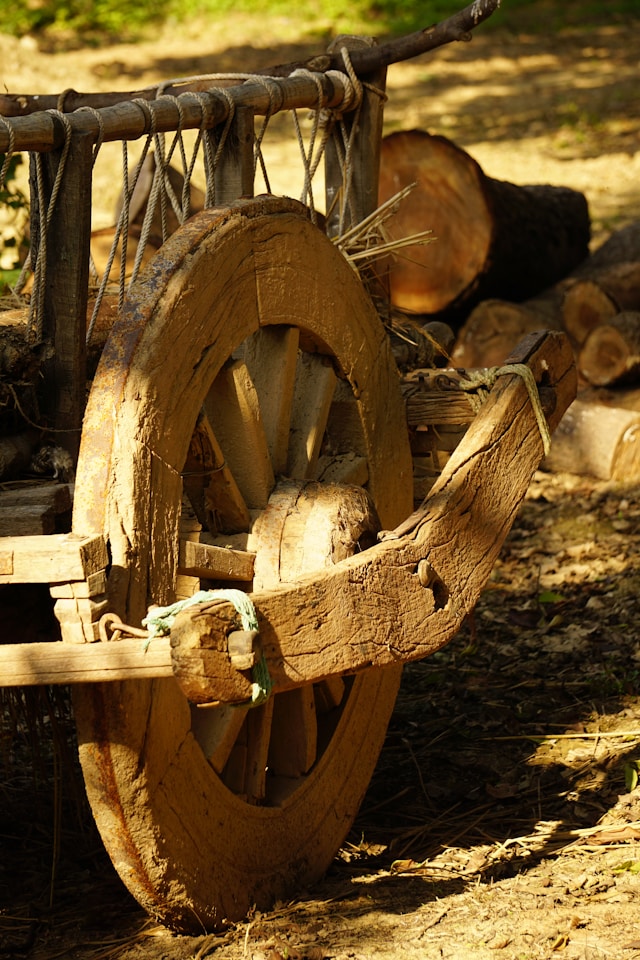
Early wheels were not the elegant spoked versions we see on Roman chariots. They were heavy, solid disks made of three planks of wood tongued and grooved together, then trimmed into a circle.
Mesopotamia and the birth of logistics
The strongest evidence traces the wheel’s invention to Mesopotamia around 3500 BCE. Interestingly, the first wheels weren’t used for transportation. They were used for pottery. The “potter’s wheel” allowed for the mass production of ceramics. Which was essential for storing grain and oil in growing urban centers.
It took roughly three centuries for someone to realize that if you flipped the potter’s wheel on its side and connected it to a cart, you could move more than a man could carry on his back.
Once the transition to vehicle wheels happened, the impact was immediate. In the Fertile Crescent, the Sumerians used four-wheeled wagons pulled by oxen or onagers (wild asses) to move heavy loads of crops from the fields to the city storehouses.
China independently invented the wheel around 2800 BCE, demonstrating that when societies reached similar technological thresholds, wheeled vehicles could emerge as a logical solution to transportation challenges.
The economic engine of the bronze age
The wheel fundamentally redefined trade. Before its invention, trade was limited to what a human could carry or what could be strapped to the back of a pack animal. This meant luxury goods were the primary items of exchange because they were light and high-value.
The wheel allowed for the transport of bulk goods. For the first time, it was economically viable to move tons of grain, timber, and building stone over long distances. This created a connected economy. A city with an abundance of grain could trade with a distant region that had surplus copper. The wheel turned local markets into regional trade networks, fueling the growth of the world’s first empires.
Bronze Age societies leveraged wheeled transport for military purposes as well. Chariots provided tactical advantages in warfare, while supply wagons enabled armies to campaign farther from home bases. These military applications further drove wheel technology refinement, as societies invested in lighter materials, spoked designs, and better axle assemblies.

Roads, bridges, and beasts of burden
Wheels only delivered their full potential when paired with supporting infrastructure and draft animals. Societies that adopted wheels invested heavily in road construction, creating transportation networks that facilitated both commerce and political control.
Bridges extended these road networks across rivers and ravines, opening previously isolated regions to wheeled trade. The engineering knowledge required to build bridges capable of supporting loaded carts represented another technological threshold societies needed to cross. Waterwheels, developed in Mesopotamia by 3500 BCE, adapted the wheel-and-axle principle for irrigation. Demonstrating how the core innovation spawned diverse applications.
Draft animals proved equally essential. Oxen and horses provided the pulling power that made wheeled vehicles practical for heavy loads. Without large domesticated animals capable of pulling carts, wheels offered limited advantages over human porters or pack animals. The co-evolution of wheel technology, road infrastructure, and animal husbandry created an integrated transportation system greater than the sum of its parts.
Why the incas didn’t need the wheel
One of the great mysteries of history is why the Inca Empire, which was technologically advanced in medicine, masonry, and governance, never used the wheel for transport. They knew about the principle, since archaeologists have found Inca “pull toys” with wheels. But they never applied it to their economy.
The reason was geography. The Inca Empire was draped across the Andes Mountains. Their roads were often steep staircases carved into cliff faces. Furthermore, the Americas lacked large draft animals like the ox or the horse. The only beast of burden available was the llama, which can carry a pack but cannot pull a heavy wagon.
The Inca case proves that technological development isn’t linear or universal. Societies adopt innovations when they solve actual problems better than existing solutions. Where terrain is mountainous, draft animals are small, and alternative transportation methods work well, wheels offer few advantages.
What made the invention of wheels possible
The wheel emerged from the convergence of metallurgy, carpentry, and practical needs such as mining and heavy-load transport. Building on these foundations, material innovations continued to improve wheel performance throughout the Bronze Age. Spoked wheel designs reduced weight while maintaining strength, and bronze reinforcements increased durability. Together, these improvements broadened the use of wheeled vehicles across different regions and terrains.
The wheel represents not just a clever invention but the culmination of centuries of technological progress, economic development, and social organization. Its impact on trade, warfare, agriculture, and daily life rippled through ancient societies, reshaping human civilization in ways that persist today