The invention of time: origins of calendars and early clocks
For most of human history, time was not something you “kept”, it was something you lived. But as human societies grew from wandering tribes into complex civilizations, we encountered a fundamental problem: nature’s rhythms were too vague for the world we were building. To navigate the open seas, to harvest enough grain to feed a city, and to trade across vast distances, we had to do the impossible. We had to capture the invisible and divide the infinite. We had to invent Time.
Before clocks and calendars, there was only the “now,” the “before,” and the “after.” The journey from simply experiencing time to actively measuring it is one of humanity’s greatest intellectual achievements.
The moment our ancestors first looked up at the sky and noticed the sun’s steady march across the heavens, time as we know it was born. Not the phenomenon itself, but the measurement of it, the act of carving infinity into manageable pieces. This breakthrough didn’t just change how we organize our days; it fundamentally rewired human civilization.
The Importance of Time
Before clocks, before calendars, before the very concept of “tomorrow” had a name, human existence flowed in an eternal present. Hunter-gatherer societies operated on immediate needs but the agricultural revolution demanded something revolutionary: planning. Growing crops required knowing when to plant, when to harvest, and when to store provisions for the lean months. The science of mathematics itself emerged from this agricultural imperative, as people studied celestial movements to calculate seasons and created the first calendars to predict their arrival.
As tribes grew into kingdoms, time became the “social glue” that allowed for Coordination. You cannot have a marketplace if no one knows when to meet. You cannot have a religion if the priests don’t know when the solstice occurs. Measuring time was the first step in organizing human willpower toward a single, synchronized goal.
The First Calendars: Watching the Moon and Stars
Before the clock, there was the sky. The most obvious unit of time was the day, governed by the rising and setting sun. The next natural unit was the month, determined by the waxing and waning of the moon. The phases of the moon were easy to track and became the basis for the earliest calendars. The earliest “instruments” were likely notched bones, such as the Ishango Bone found in Africa, which some archaeologists believe tracks the phases of the moon.
The hardest unit to grasp was the year. Recognizing that the seasons cycled over a long period required generations of observation. Ancient astronomers noticed that different constellations appeared at different times of the year, or that the sun rose at slightly different points on the horizon depending on the season. The Babylonians and Egyptians realized that by watching the “dog star” Sirius they could predict the exact moment the seasons would reset
Early tribes and celestial tracking
Contrary to assumptions about primitive simplicity, early tribes proved remarkably sophisticated in tracking celestial cycles. Stonehenge, that iconic ring of standing stones on England’s Salisbury Plain, functioned as a massive astronomical observatory and timekeeping device. The site’s northeast entrance aligns precisely with sunrise on the summer solstice, while the winter solstice sunset aligns through the great trilithon.
By building these megalithic structures, ancient peoples were “pinning down” the sun. It allowed them to create a fixed point in the year, a cosmic “Reset” button that told the entire community exactly where they stood in the cycle of life and death. Similar structures exist globally, from the Chankillo solar observatory in Peru to the medicine wheels of North America.

How early peoples measured time?
Different cultures developed unique ways of slicing up eternity, often independently.
- The Egyptians (c. 3000 BCE): living along the Nile, their lives depended on the river’s annual flooding. They developed a solar calendar of 365 days, divided into 12 months of 30 days, plus five extra festival days at the end of the year. They were also among the first to divide the day into smaller parts, eventually leading to our 24-hour system.
- The Sumerians and Babylonians (c. 2000 BCE): located in modern-day Iraq, these Mesopotamian cultures were mathematical powerhouses. They used a “sexagesimal” (base-60) numbering system. Why 60? It’s easily divisible by 2, 3, 4, 5, and 6. This base-60 system is the direct ancestor of why we have 60 seconds in a minute and 60 minutes in an hour. They also relied heavily on lunar calendars, requiring complex adjustments to keep them aligned with the solar year.
- The Maya (c. 2000 BCE – 1500 CE): in Mesoamerica, the Maya were obsessed with time. They didn’t just have one calendar; they had interlocking systems. They used a 260-day sacred calendar (Tzolkin) running alongside a 365-day solar calendar (Haab). These would align like meshing gears every 52 years, a major cycle in their culture.
Instruments to measure time
Once the concepts of time were established, humans built hardware to track them.
Sundials and Shadow Clocks
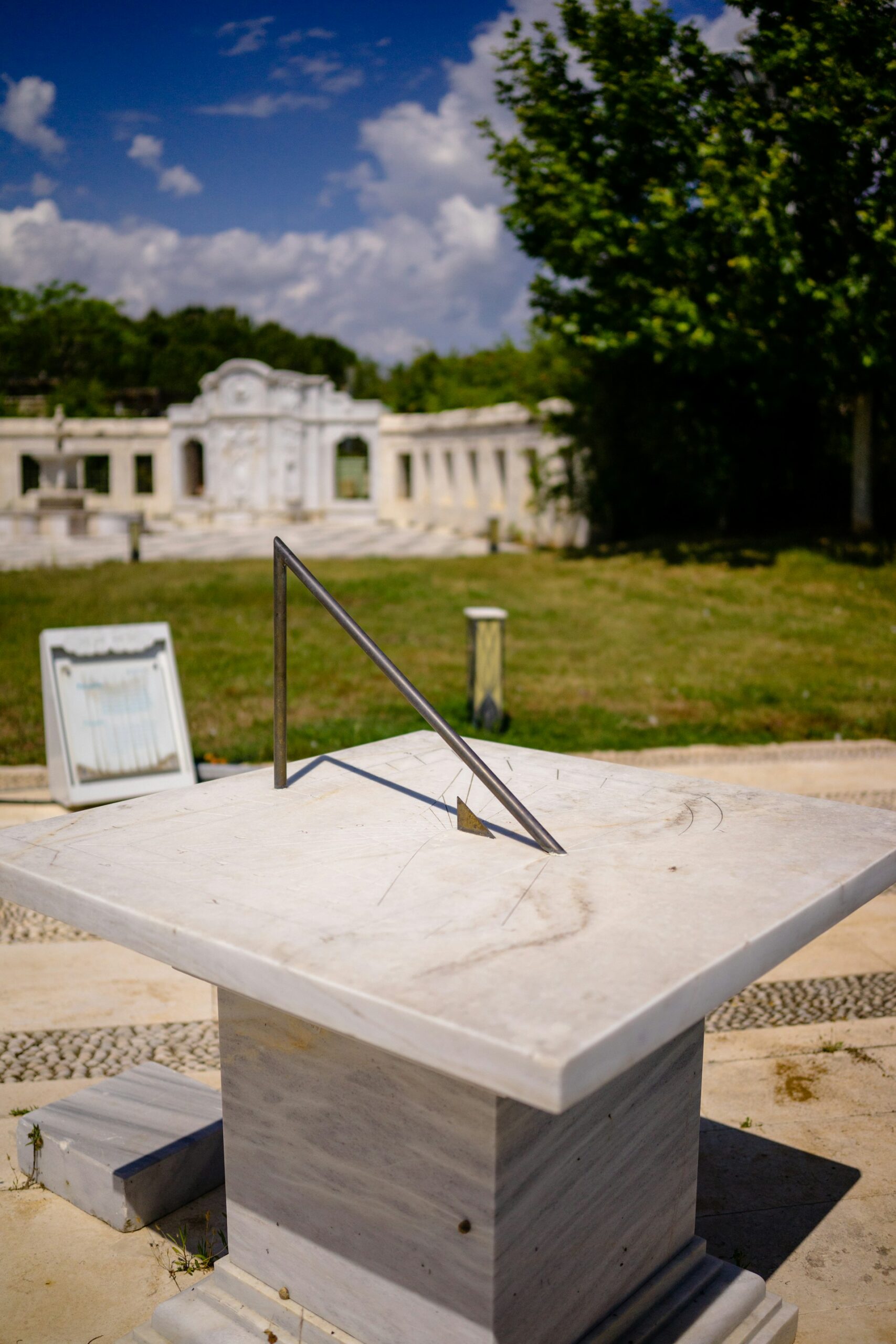
The oldest scientific instrument is likely a stick in the ground. By tracking the length and direction of the shadow, you could tell how far “through” the day you were. The Egyptians refined this into portable “shadow clocks,” and later, the Greeks and Romans perfected complex hemispherical sundials. Their major flaw, obviously, was their uselessness at night or on cloudy days.
Water Clocks (Clepsydra)
To solve the night problem, various cultures (including Egyptians, Babylonians, and Chinese) developed water clocks. The premise was simple: fill a vessel with water and let it drip out of a small hole into another marked vessel. The water level indicated how much time had passed. These were crucial for timing speeches in law courts or ensuring night watchmen didn’t slack off.
The Hourglass
A later invention, likely appearing in Medieval Europe around the 8th century CE, the hourglass used sand instead of water. Sand had a major advantage: it didn’t freeze in northern winters, and it didn’t slosh around on ships, making it ideal for early ocean voyages.
The hourglass allowed sailors to keep “watch” and, more importantly, to estimate their dead reckoning. By knowing how long they had been traveling at a certain speed, they could calculate their position on a featureless ocean. Time measurement was the key that unlocked the global trade routes of the Age of Discovery.

Role of time in agriculture, trade, and navigation
The invention of timekeeping was practically applied to every facet of life.
In agriculture, the calendar was the farmer’s almanac. Knowing when the Nile would flood or when the rainy season would begin in the Maya lowlands was a matter of life and death. Grain storage became systematic rather than ad hoc. Surpluses accumulated, supporting populations large enough to build cities, employ specialized craftsmen, and sustain standing armies. Time measurement was the invisible infrastructure of civilization.
In trade, standardized time allowed for complex contracts. The Babylonian calendar’s influence spread across trade networks, becoming the temporal framework for commerce from Mesopotamia to Egypt and beyond. When caravans departed, their departure dates were recorded. When ships sailed, their sailing times were noted. Archaeologists believe writing itself emerged around 8000 BCE from the need to record trade transactions across distances. Clay tokens representing goods evolved into cuneiform tablets, the world’s first writing system, because merchants needed to document what was shipped, when, and to whom.
In navigation, understanding the movements of the stars, nature’s nighttime clock, allowed sailors to venture further from shore by helping them determine their latitude. The hourglass revolutionized maritime exploration. Sand flowed reliably regardless of conditions. Marine sandglasses, appearing in European ships by the 14th century, typically measured half-hour intervals. A sailor would turn the glass, note the time, and log the ship’s speed using a chip log. By knowing how long they’d traveled at what speed, navigators could approximate their position. The ability to measure time at sea transformed navigation from guesswork into calculation, opening continents to trade and conquest.
The civilizational impact of the invention of time
The invention of time measurement created the conceptual framework for everything that followed. Mathematics grew from astronomical calculations. Writing emerged from trade records. Cities synchronized their activities to common schedules. Armies coordinated campaigns across distances. Empires administered territories spanning continents.
The Babylonian calendar’s 12-month system, 24-hour day, and 60-minute hour became the foundation for the Julian calendar, which evolved into our modern Gregorian system. Every time you check your watch, you’re participating in a tradition stretching back 5,000 years to Egyptian priests timing rituals, to Babylonian astronomers charting planets, to Neolithic builders aligning stones with celestial events
Our ancestors looked at the sky and sought to tame its overwhelming vastness by dividing it into understandable chunks. In doing so, they didn’t just invent clocks; they built the framework for modern civilization.