The origins of maritime exploration: how early humans conquered the seas
The history of human maritime exploration represents one of our species’ most remarkable achievements. Long before the age of modern navigation instruments, humans ventured across waters using nothing but their ingenuity, observation, and courage.
The earliest explorers developed watercraft and navigational techniques that enabled them to traverse rivers, coastal waters, and eventually vast oceanic expanses. This journey spans hundreds of thousands of years and multiple continents, with distinct achievements emerging across Island Southeast Asia, the Pacific, and the Mediterranean.
The First Initiatives of Seafaring: Breaking the Water Barrier
The earliest evidence of human seafaring dates back further than once believed. Archaeological discoveries on Crete, Greece, revealed stone tools approximately 130,000 years old, indicating that Homo sapiens or their ancestors possessed the cognitive ability and technological sophistication to construct boats capable of open-sea navigation. These tools could only have reached Crete through deliberate sea voyages, likely crossing stretches of open water as far as 320 kilometers from the African coast.
By the Late Pleistocene period, seafaring had become more established in multiple regions. Evidence from Indonesia demonstrates that by approximately 900,000 years ago, hominins were crossing waters between islands in Wallacea, establishing settlements on New Ireland, Gebe Island, and other distant locations.
The earliest surviving watercraft provide crucial insights into these pioneering efforts. The Pesse canoe, a dugout craft, represents some of the oldest evidence of boat construction, dating to around 10,000 years ago. However, prehistoric mariners likely relied on simpler designs initially: rafts made from bundled reeds or logs required minimal woodworking skills and could be constructed quickly from available materials. As civilizations advanced, more sophisticated designs emerged, combining stability with cargo capacity, critical innovations for supporting long-distance exploration and settlement.
The Austronesian Expansion: masters of the Indo-Pacific
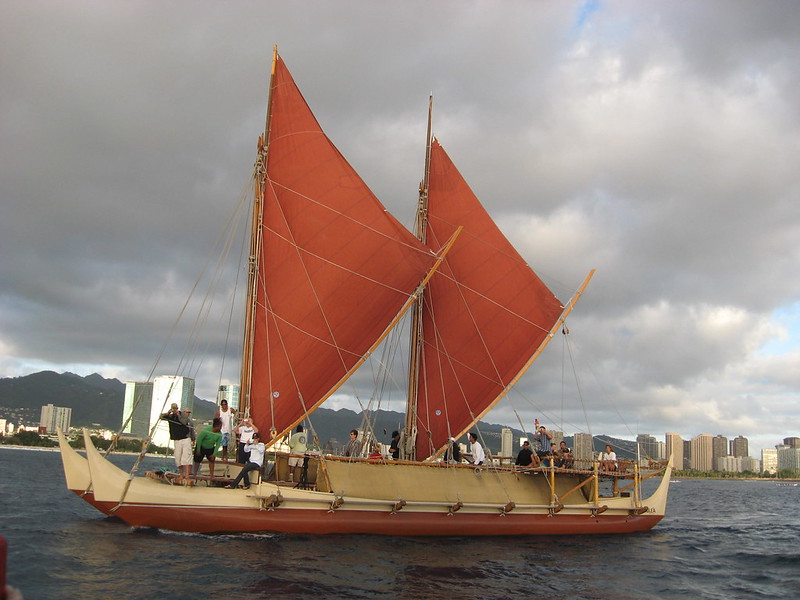
The Austronesian peoples represent perhaps the greatest maritime achievement in human history. Beginning around 3000 BCE from Taiwan, Austronesian-speaking seafarers initiated a diaspora that would span nearly 5,000 miles in just over 2,000 years, ultimately reaching Madagascar to the west and the furthest islands of the Pacific to the east.
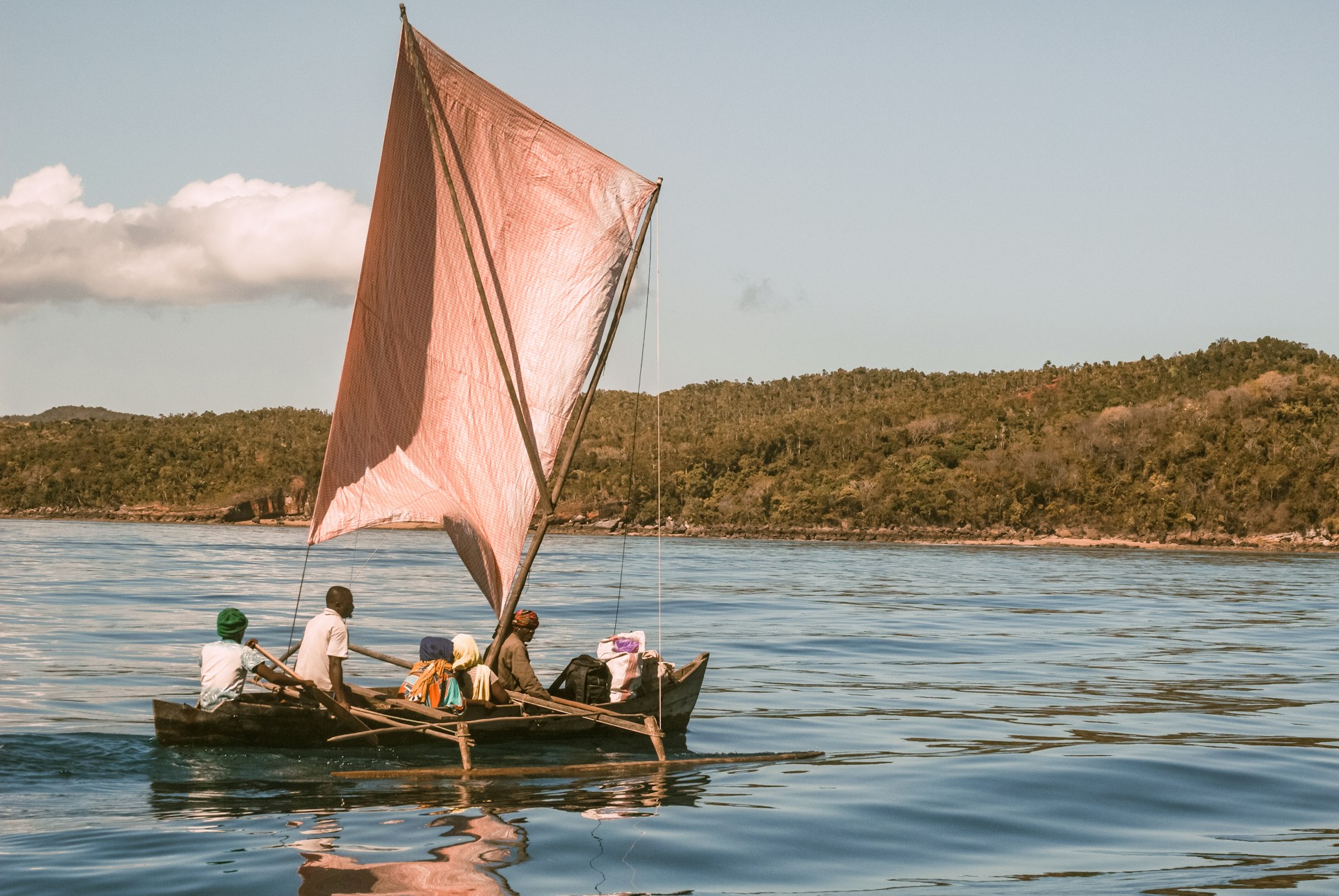
The technology that enabled this extraordinary expansion centered on the outrigger canoe and its variants. The double-hulled canoe featured two large hulls of equal length lashed side by side, creating storage capacity for food, hunting materials, and water.
These vessels were remarkably efficient: a Tongan double canoe could carry 80 to 100 people, while smaller outrigger vessels equipped for fishing carried 40 to 50 people. The stability provided by outrigger floats or parallel hulls made these designs superior to single-hulled vessels for navigating rough seas, a critical advantage when crossing the Pacific’s challenging waters.
The Austronesian expansion proceeded in stages. By around 1500 BCE, their descendants had colonized Micronesia, launching from the Philippines across open water. By 900 BCE, they had spread more than 4,000 miles across the Pacific, reaching Tonga and Samoa, establishing the foundation for Polynesian culture. Within the following centuries, Polynesians reached Hawaii, New Zealand, Easter Island, and possibly South America, displaying an extraordinary mastery of oceanic navigation across one of Earth’s most challenging maritime environments.
Mediterranean navigation: adaptation and innovation
Mediterranean maritime development followed a different trajectory, shaped by the region’s geography and the emergence of multiple competing civilizations. Unlike the vast Pacific expanses navigated by Austronesians and Polynesians, Mediterranean navigation initially centered on coastal routes and island-hopping across shorter distances.
The earliest Mediterranean seafarers emerged around the Bronze Age. The Minoans of Crete, flourishing from approximately 2700 to 1450 BCE, became accomplished sailors. Their settlements on Thera (modern Santorini) and trade connections to Egypt required multi-day open-water voyages, suggesting that Minoan navigators possessed considerable skills in reading celestial objects. Archaeological evidence and artistic representations indicate that Minoan vessels featured masts and sails by the Middle Bronze Age, combining oar and sail propulsion to maximize flexibility in varying wind conditions.
The ancient Egyptians developed maritime capabilities independently, driven by their vast Nile River navigation tradition and their need to access resources unavailable along the Nile valley. Egyptian shipwrights developed a distinctive construction technique using edge-joined thick planks secured with deep, unpegged mortise-and-tenon joints that allowed hulls to flex with water movement rather than shattering under stress. Evidence from harbor sites at Mersa/Wadi Gawasis and Ayn Soukhna reveals that Egyptians dismantled ships built on the Nile, carried them across the desert in component parts and reassembled them at Red Sea ports for long-distance voyages.
The Phoenicians emerged as the Mediterranean’s most accomplished seafarers, dominating sea routes from approximately 1200 to around 800 BCE. Their geographic position between the Fertile Crescent and Egyptian empires, combined with access to timber and Mediterranean ports, positioned them to become master traders. They pioneered navigation by celestial observation, particularly using the Pole Star (which the Phoenicians knew as the “stella Phoenica”) for nighttime orientation. These sailors were among the first to navigate by stars rather than hugging coastlines, revolutionizing Mediterranean seafaring.
Caribbean Navigation: Indigenous Innovation
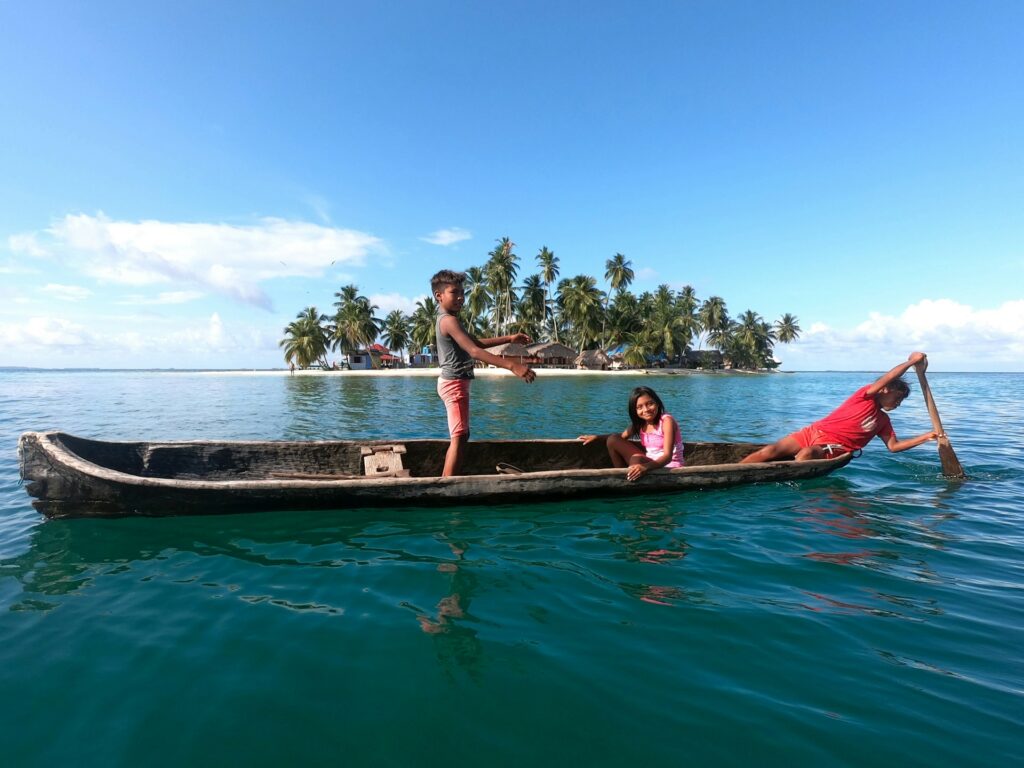
Pre-Columbian Caribbean seafaring represents a distinct maritime tradition shaped by the region’s geography and resources. Unlike the Pacific’s vast empty expanses or the Mediterranean’s network of nearby islands, the Caribbean presented a unique challenge: islands separated by hundreds or even thousands of miles of open water, with limited visibility between them.
The primary Caribbean seagoing vessel was the dugout canoe, carved from single large logs typically of ceiba, mahogany, or other buoyant tropical hardwoods. These vessels could carry substantial cargo and numerous passengers, with larger examples capable of holding 80 or more people.
Caribbean peoples established exchange networks linking the islands to each other and to mainland South America, facilitated by canoe transport and sophisticated knowledge of navigation and local geography.
Technologies That Enabled Early Exploration
Success in early maritime exploration depended on multiple technological and knowledge-based systems. Watercraft design proved fundamental: whether the outrigger canoes of the Austronesians, the Phoenician merchant vessels, Egyptian Red Sea ships, or Caribbean dugout canoes, each represented sophisticated engineering adapted to specific environmental conditions and purposes.
Human maritime achievement represents a progression from audacious experiments crossing seemingly impossible distances to systematic networks of regular trade and exploration. From the earliest Mediterranean crossings 130,000 years ago through the Austronesian colonization of the Pacific to Phoenician domination of Mediterranean trade, humans repeatedly expanded the boundaries of the possible.
These early navigators possessed neither compasses nor chronometers, yet they achieved feats of seamanship that modern instruments render routine. Their legacy, the networks they established, the knowledge they preserved, and the cultural exchange they facilitated, shaped human civilization for millennia to come.